
×
A business tax return is an income tax return filed by business entities such as proprietorships, partnerships, LLPs, and companies. It is a detailed financial statement that reports the total income earned, expenses incurred, and overall tax liability of the business for a particular financial year. The return is submitted in the prescribed format as notified by the Income Tax Department and must accurately reflect the financial position of the enterprise.
In addition to reporting profits and losses, a business income tax return includes important financial details such as fixed assets, capital investments, loans taken or given, outstanding debtors and creditors, and other relevant financial transactions. Businesses are also required to report details of Tax Deducted at Source (TDS) and ensure that taxes deducted or collected have been properly accounted for.
Filing the business tax return annually is a
statutory obligation under the Income Tax Act. Timely submission within the
prescribed due date is crucial to avoid penalties, interest, and legal
consequences. Proper filing also enhances transparency, supports financial
planning, and strengthens credibility with banks, investors, and regulatory
authorities.
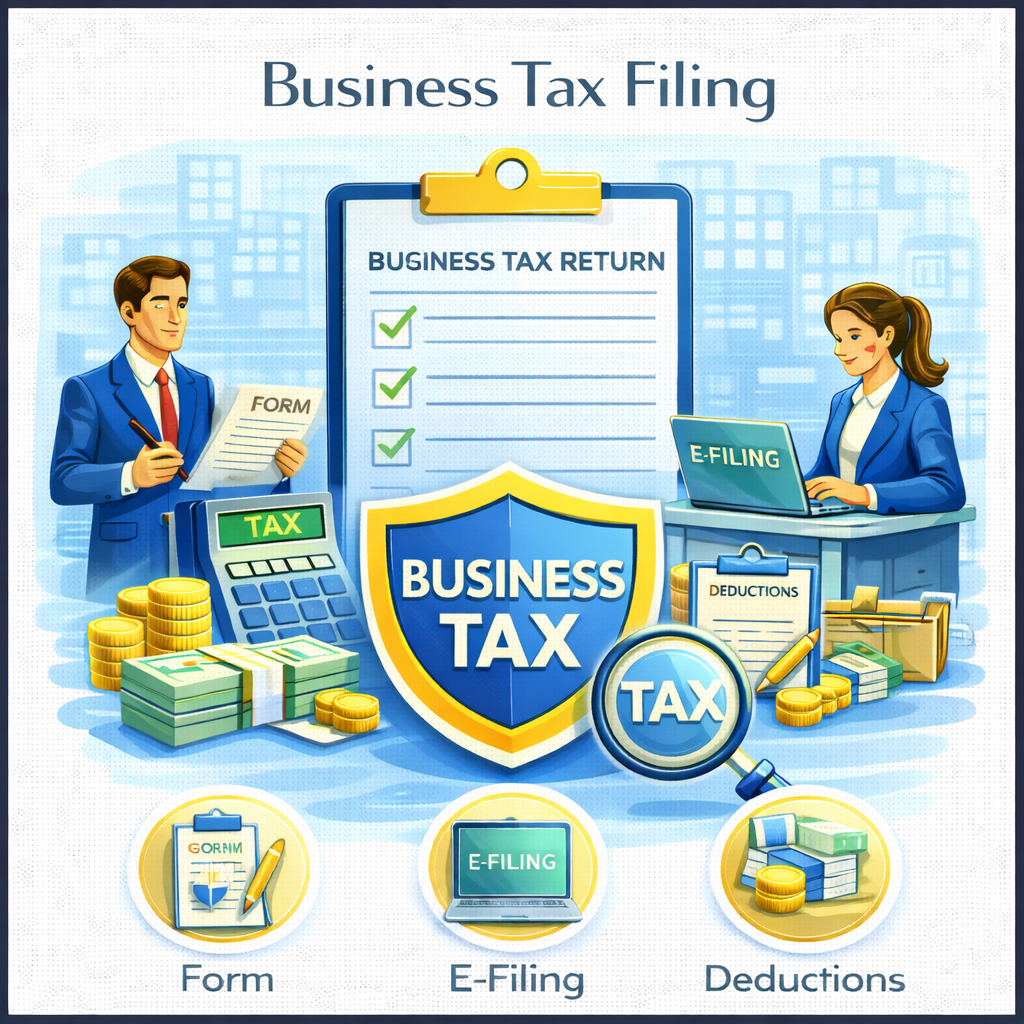
Business
income tax return filing varies depending on the legal structure of the
business entity. Each type of business is required to file its return using the
applicable form and comply with specific provisions under the Income Tax Act.
Below are the main categories:
- Proprietorship Tax Return Filling: In a sole proprietorship, business income is reported as part of the individual owner’s income tax return under the appropriate ITR form.
- Partnership Firm Tax Return Filling: Partnership firms are required to file their income tax returns, reporting total income, expenses, and profit-sharing details among partners.
- Limited Liability Partnership (LLP) Tax Return Filling: LLPs must file their returns separately, declaring business income, expenses, and tax liabilities as per applicable tax regulations.
- Company Tax Return Filling: Private and public limited companies are required to file corporate income tax returns, including audited financial statements and statutory disclosures.
Each
category follows distinct compliance requirements, making it essential to file
according to the specific business structure.
To
file a business income tax return accurately and in compliance with the Income
Tax Act, the following documents are generally required:
Basic
Documents:
- PAN
Card of the business entity
- Aadhaar
Card (for proprietor, if applicable)
- Certificate
of Incorporation / Partnership Deed / LLP Agreement
- GST
Registration Certificate (if applicable)
Financial Statements:
- Profit
& Loss Account
- Balance
Sheet
- Trial
Balance
- Cash
Flow Statement (if prepared)
Bank & Transactions Details:
- Bank
statements for the financial year
- Details
of loans taken or given
- Details
of fixed assets and depreciation
Income & Expense Proof:
- Sales
and purchase invoices
- Expense
bills and vouchers
- Details
of debtors and creditors
Tax-Related Documents:
- TDS
Certificates (Form 16A, 16B, etc.)
- Form
26AS / AIS / TIS
- Advance
tax payment challans
- GST
returns (if applicable)
Additional Documents (If Applicable):
- Audit
Report (if tax audit is applicable)
- Details
of investments and deductions claimed
Proper
documentation ensures accurate filing, minimizes errors, and reduces the risk
of notices from tax authorities.
Filing
an Income Tax Return (ITR) for business income provides multiple financial and
legal advantages that contribute to smooth and sustainable operations.
- Refund
Claims:
Accurate and timely filing may result in tax refunds, improving the company’s
cash flow and liquidity.
- Carry
Forward of Losses:
Business losses can be carried forward to future years and set off against profits,
reducing future tax liabilities.
- Proof
of Financial Transactions:
Filed returns serve as documented evidence of business income, expenses, and
transactions, useful for legal, contractual, or compliance purposes.
- Legal
Compliance:
Timely business tax filing ensures adherence to income tax regulations and helps
avoid penalties, interest, and legal consequences.
- Ease
in Loan Approvals:
Properly filed ITRs act as proof of income and financial stability, increasing
credibility with banks and financial institutions when applying for loans or
credit facilities.
- Enhanced
Transparency & Credibility:
Transparent reporting builds trust with investors, vendors, and stakeholders.
- Audit
Readiness: Properly
filed returns create a reliable financial record, making the business prepared
for scrutiny or audits.
- Optimized
Tax Planning:
Filing within the prescribed due date allows businesses to claim deductions and
maximize legitimate tax benefits while reducing the risk of tax notices.
Related Services


Why Choose Arthtattava
Expert-Led Financial Solutions: Our team combines deep domain expertise with practical experience across industries.
End-to-End Accounting Support: From bookkeeping to reporting, we manage complete financial operations seamlessly.
Technology-Driven Approach: We leverage advanced tools like Tally, OCR, and automation for accuracy.
Customized Business Solutions: Every service is tailored to your business needs, scale, and growth stage.
Data Accuracy & Compliance Focus: We ensure error-free records while strictly adhering to regulatory requirements.
Reliable & Timely Delivery: Consistent turnaround times with proactive communication to support business decisions.
Know More Details