
×
Statutory Audit is a legally mandated audit service conducted to examine and verify the accuracy, completeness, and fairness of an organization’s financial statements in accordance with applicable laws and accounting standards. It is typically required under governing regulations such as the Companies Act and other relevant statutes, depending on the type and size of the entity. The primary objective of a statutory audit is to ensure that the financial statements present a true and fair view of the company’s financial position and performance for a given financial year.
A statutory audit is carried out by an independent Chartered Accountant or audit firm to maintain objectivity and credibility. The audit process involves detailed examination of books of accounts, financial records, internal controls, supporting documents, and compliance with statutory requirements. Auditors also assess risk areas, detect material misstatements, and evaluate whether proper accounting policies have been followed.
Statutory Audit services not only ensure regulatory compliance but also enhance transparency and accountability within the organization. The audit report increases the confidence of shareholders, investors, lenders, and regulatory authorities. Additionally, it helps management identify operational inefficiencies, strengthen internal controls, and improve financial governance. Overall, statutory audit services play a crucial role in maintaining financial discipline and reinforcing stakeholder trust.
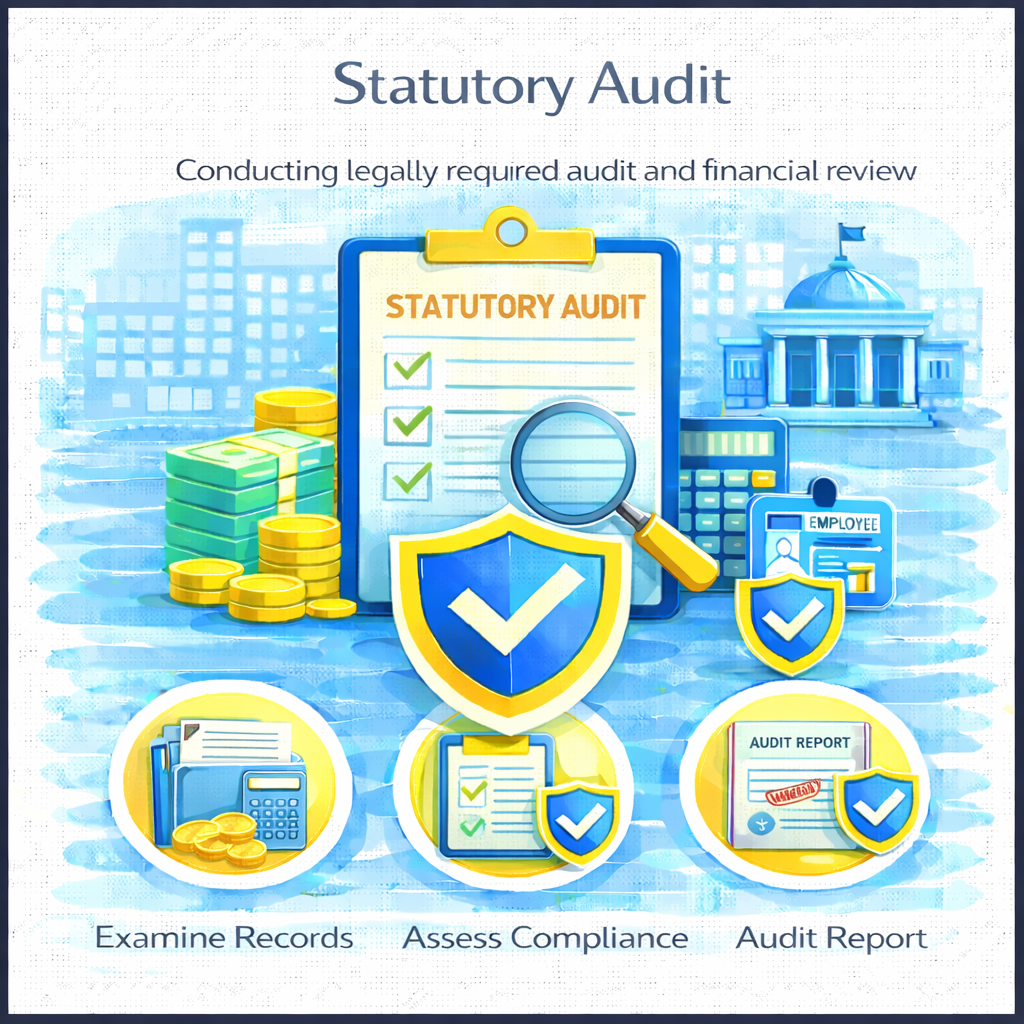
Statutory Audit
In Stock
₹0
0%
Off
Verification Documents Required
- Memorandum of Association (MOA)
- Articles of Association (AOA) (AOA)
- Board Resolution Copy (Board resolution)
Statutory
Audit is mandatory for certain entities based on their legal structure,
turnover, or regulatory requirements. The eligibility criteria generally
include the following:
- Companies Registered under the Companies Act, 2013: All
Private Limited Companies, Public Limited Companies, and One Person Companies (OPC) are
required to conduct a statutory audit, irrespective of their turnover or profit
level.
- Limited Liability Partnerships (LLPs): An
LLP must undergo a statutory audit if; (a) Its
annual turnover exceeds ₹40 lakh, or (b) Its
capital contribution exceeds ₹25 lakh.
- Partnership Firms and Proprietorships (Under Income Tax Act
– Tax Audit applicability): Although
not covered under the Companies Act, businesses may require audit under the
Income Tax Act if turnover exceeds prescribed limits.
- Entities Covered by Other Regulatory Authorities: Banks,
insurance companies, NBFCs, charitable trusts, and certain institutions are
subject to statutory audit as per specific governing laws.
- Special Statutory Requirements: Entities
receiving government grants, subsidies, or engaged in regulated sectors may
also be required to conduct audits.
Statutory
audit ensures financial transparency, regulatory compliance, and credibility of
financial statements for eligible entities.
Complete checklist of documents required for a Statutory Audit in India (as per Companies Act 2013) is as follows:
- Basic Business Information: PAN/ TAN of the company, MOA & AOA (if applicable), CIN Details, GST Registration Certificate etc.
- Books Of Accounts: Bank & Cash Book, Trial Balance, Profit & Loss Account, Balance Sheet, Fixed Asset Register, Ledger & Journal Book etc.
- Bank And Financial Statements: Bank Statements (all accounts), Bank Reconciliation Statements, Loan Statements (Term loans, CC, OD), Interest Certificates from banks etc.
- Sales & Purchase Details: Sales & Purchase Register (including GST details), Debtors & Creditors with ageing, Export/Import details (if any), E-way bills (if applicable) etc.
- GST Related Documents: GSTR-1, GSTR-3B returns, GSTR-9 & GSTR-9C (if applicable), GST reconciliation (Books vs Returns), Input Tax Credit (ITC) details etc.
- Expense & Income Proof: All major expense bills (rent, salary, electricity, etc.), TDS deducted on expenses, Other income details (interest, commission, etc.)
- TDS/TCS Details: TDS Returns (Form 24Q, 26Q, etc.), Form 26Q / 24Q working, Form 26AS / AIS / TIS, TDS Certificates (Form 16, 16A).
- Fixed Assets & Investments: Fixed Asset purchase invoices, Depreciation working, Sale of asset details (if any), Investment Details (Shares, Mutual Funds etc.)
- Payroll & Employee Details: Salary Register, PF & ESI returns, Employment agreements (if any), Bonus/ incentive details.
- Inventory/ Stock Details: Stock Register, Closing stock valuation method, Physical stock verification report (if available).
- Statutory Compliance Documents: Board meeting minutes, AGM minutes, ROC fillings, Related party transactions, Contracts & agreements.
- Financial & Audit Documents: Previous year Audited financials, Audit report, Internal audit report (If Any), Notes of accounts.
- Other Important Details: Contingent Liabilities, Pending litigations, Loans Advances given/received, Capital structure changes, CSR details (If Any).
Statutory
Audit offers several important advantages for businesses and stakeholders:
- Legal Compliance: Ensures
adherence to applicable laws and regulatory requirements, helping organizations
avoid penalties, legal action, and compliance issues.
- Enhanced Credibility: An
independent audit report increases the trust and confidence of shareholders,
investors, lenders, and regulatory authorities in the company’s financial
statements.
- Financial Transparency: Verifies
that financial statements present a true and fair view of the company’s
financial position and performance.
- Detection of Errors and Fraud: Helps
identify accounting errors, discrepancies, and potential fraudulent activities,
strengthening internal control systems.
- Improved Financial Management: Provides
insights into operational inefficiencies and financial risks, enabling better
decision-making and governance.
- Better Access to Funding: Audited
financial statements are often required by banks and investors for loans,
credit facilities, or investment approvals.
- Strengthened Internal Controls: Encourages
organizations to maintain systematic records and robust financial procedures.
Overall,
a statutory audit enhances accountability, transparency, and long-term
financial stability.
Related Services


Why Choose Arthtattava
Expert-Led Financial Solutions: Our team combines deep domain expertise with practical experience across industries.
End-to-End Accounting Support: From bookkeeping to reporting, we manage complete financial operations seamlessly.
Technology-Driven Approach: We leverage advanced tools like Tally, OCR, and automation for accuracy.
Customized Business Solutions: Every service is tailored to your business needs, scale, and growth stage.
Data Accuracy & Compliance Focus: We ensure error-free records while strictly adhering to regulatory requirements.
Reliable & Timely Delivery: Consistent turnaround times with proactive communication to support business decisions.
Know More Details