
×
GSTR-9 is the annual return that registered taxpayers under the GST regime are required to file, subject to the prescribed turnover limits and applicable exemptions. This return provides a comprehensive summary of all business transactions carried out during the financial year. It includes detailed information about outward supplies (sales), inward supplies (purchases), taxes collected and paid under CGST, SGST, and IGST, as well as input tax credit claimed during the year.
GSTR-9 consolidates the data already reported in monthly or quarterly returns such as GSTR-1 and GSTR-3B, ensuring that the yearly figures match the periodic filings. It also captures details of total turnover, tax liabilities, refunds claimed, demands raised, and other relevant compliance information for the year. The purpose of this return is to provide a complete and transparent overview of the taxpayer’s GST activities for the financial year.
Currently, businesses with an aggregate annual turnover exceeding ₹2 crore are generally required to file GSTR-9. For taxpayers with turnover up to ₹2 crore, filing the annual return is optional, subject to government notifications for the relevant financial year.
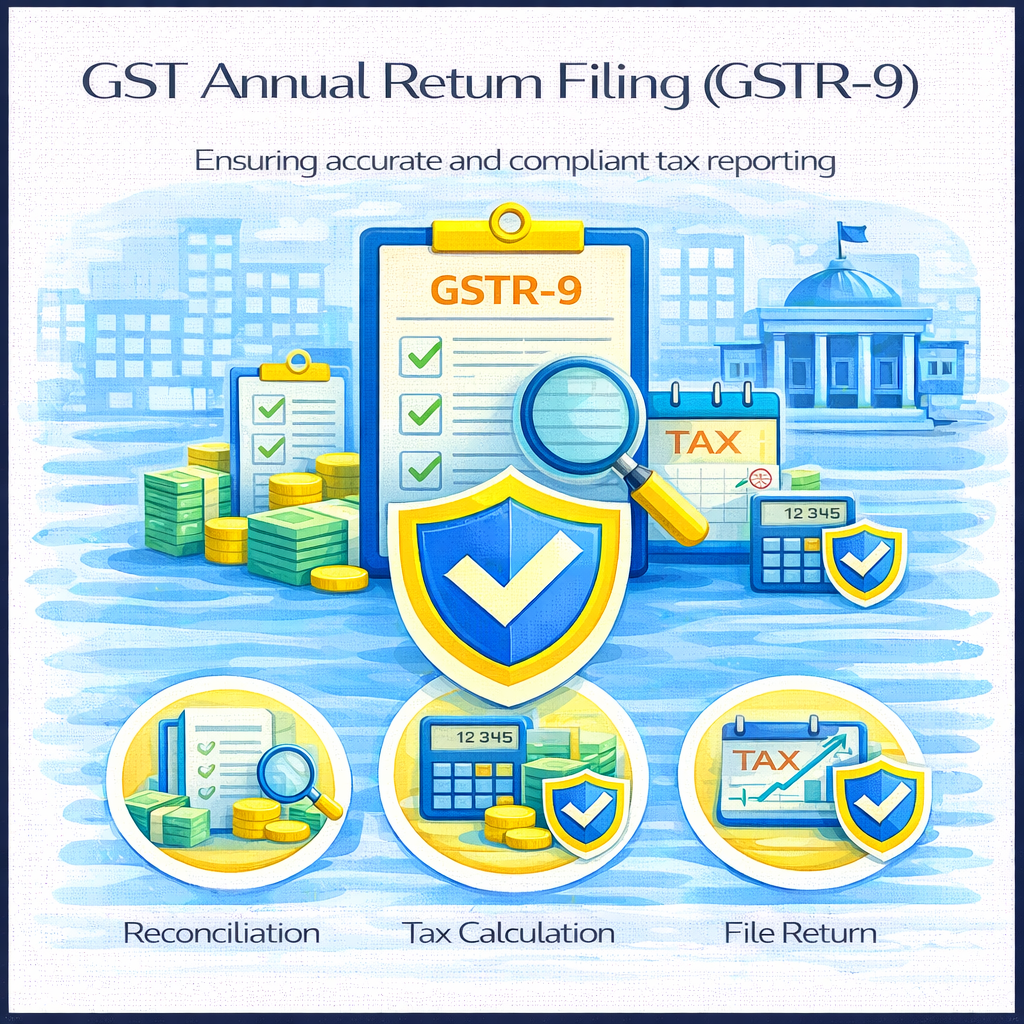
GST Annual Return Filing (GSTR-9) is a mandatory yearly compliance requirement for taxpayers registered under the Goods and Services Tax (GST) regime in India. It serves as a consolidated summary of all monthly or quarterly GST returns filed during a financial year, including details of outward supplies, inward supplies, input tax credit (ITC) availed, tax paid, and other relevant information. Filing GSTR-9 helps reconcile the information reported in various GST returns such as GSTR-1, GSTR-3B, and other related filings to ensure accuracy and transparency in tax reporting.
Our GST Annual Return Filing service assists businesses in preparing and filing GSTR-9 accurately and on time. The process includes detailed reconciliation of turnover, taxes paid, and input tax credit with financial statements and GST returns filed during the year. We identify discrepancies, ensure proper classification of transactions, and help rectify errors before submission to avoid penalties or notices from tax authorities.
This service is beneficial for businesses seeking to maintain proper GST compliance and financial transparency. Our team of professionals reviews all GST records, verifies data consistency, and prepares the annual return in accordance with the latest GST regulations. By outsourcing GSTR-9 filing to experts, businesses can reduce compliance risks, ensure timely filing, and focus on their core operations while remaining fully compliant with GST laws.
The
obligation to file Form GSTR-9 (Annual Return)
applies to specific categories of registered taxpayers based on their
registration type, turnover, and business activities during the financial year.
The following entities are generally required to file GSTR-9, subject to
applicable exemptions and turnover thresholds:
- All
regular taxpayers registered under GST are required to file GSTR-9. This
includes individuals, proprietorships, partnerships, LLPs, and companies
operating under the regular GST scheme.
- Special
Economic Zone (SEZ) units and SEZ developers must also file GSTR-9 to report
their annual GST transactions, including zero-rated supplies and other taxable
activities carried out during the financial year.
- Businesses
that have shifted from the Composition Scheme to the regular GST scheme during
the financial year are required to file GSTR-9 for the period during which they
were registered as regular taxpayers. This ensures accurate reporting following
their transition to the standard tax framework.
Timely
filing of GSTR-9 helps maintain compliance and ensures proper reconciliation of
annual GST data.
To
accurately file Form GSTR-9 (Annual Return),
the following documents and records are generally required:
- Monthly / Quarterly GST Returns: GSTR-1 (details of outward supplies), GSTR-3B (summary return of tax payments), GSTR-2A / GSTR-2B (auto-generated inward supply statements).
These
returns help compile and verify annual sales, purchases, input tax credit
(ITC), and tax payments.
- Annual Financial Statement: Profit & Loss Account, Balance Sheet
These
statements are necessary to reconcile turnover and tax data reported in GST
returns with the books of accounts.
- Reconciliation
Statement (GSTR-9C) – If Applicable
For taxpayers subject to audit requirements (as notified), GSTR-9C is required to reconcile financial statements with GST returns and ensure accuracy and compliance.
Maintaining proper documentation ensures smooth filing and reduces the risk of discrepancies or notices from tax authorities.
Filing
GSTR-9 offers several important
advantages for registered taxpayers under the GST regime:
- GSTR-9
fulfills the mandatory annual return requirement under GST law, helping
businesses remain fully compliant and avoid penalties or notices from tax
authorities.
- It
provides a comprehensive summary of all outward supplies, inward supplies,
input tax credit (ITC) claimed, and taxes paid during the financial year,
ensuring transparency and accuracy.
- Filing
GSTR-9 helps reconcile data reported in monthly or quarterly returns (such as
GSTR-1 and GSTR-3B) with the books of accounts, reducing discrepancies.
- Accurate
annual reporting minimizes the chances of future scrutiny, assessments, or tax
disputes.
- Timely
filing improves the taxpayer’s compliance track record, enhancing credibility
with authorities, lenders, and business partners.
- The
annual review of GST data helps identify errors, optimize tax positions, and
improve financial management for future periods.
Overall,
GSTR-9 filing promotes transparency, compliance discipline, and long-term
business stability.
Related Services


Why Choose Arthtattava
Expert-Led Financial Solutions: Our team combines deep domain expertise with practical experience across industries.
End-to-End Accounting Support: From bookkeeping to reporting, we manage complete financial operations seamlessly.
Technology-Driven Approach: We leverage advanced tools like Tally, OCR, and automation for accuracy.
Customized Business Solutions: Every service is tailored to your business needs, scale, and growth stage.
Data Accuracy & Compliance Focus: We ensure error-free records while strictly adhering to regulatory requirements.
Reliable & Timely Delivery: Consistent turnaround times with proactive communication to support business decisions.
Know More Details