
×
GSTR 10, commonly referred to as the Final Return, must be filed by
taxpayers whose GST registration has been cancelled or voluntarily surrendered.
This return is required to formally close GST compliance obligations. It must
be submitted within three months
from the date of cancellation or the date of the cancellation order, whichever
is later.
GSTR-10
is a concise return that captures essential information, including:
- GSTIN
of the taxpayer
- Effective
date of cancellation or surrender of registration
- Reason
for cancellation or deregistration
- Details
of stock and capital goods held on the date of cancellation (if applicable)
- Name
and signature of the authorized signatory
- Contact
details of the authorized signatory
Timely
filing of GSTR-10 ensures proper closure of GST registration and helps avoid
penalties or further compliance issues.
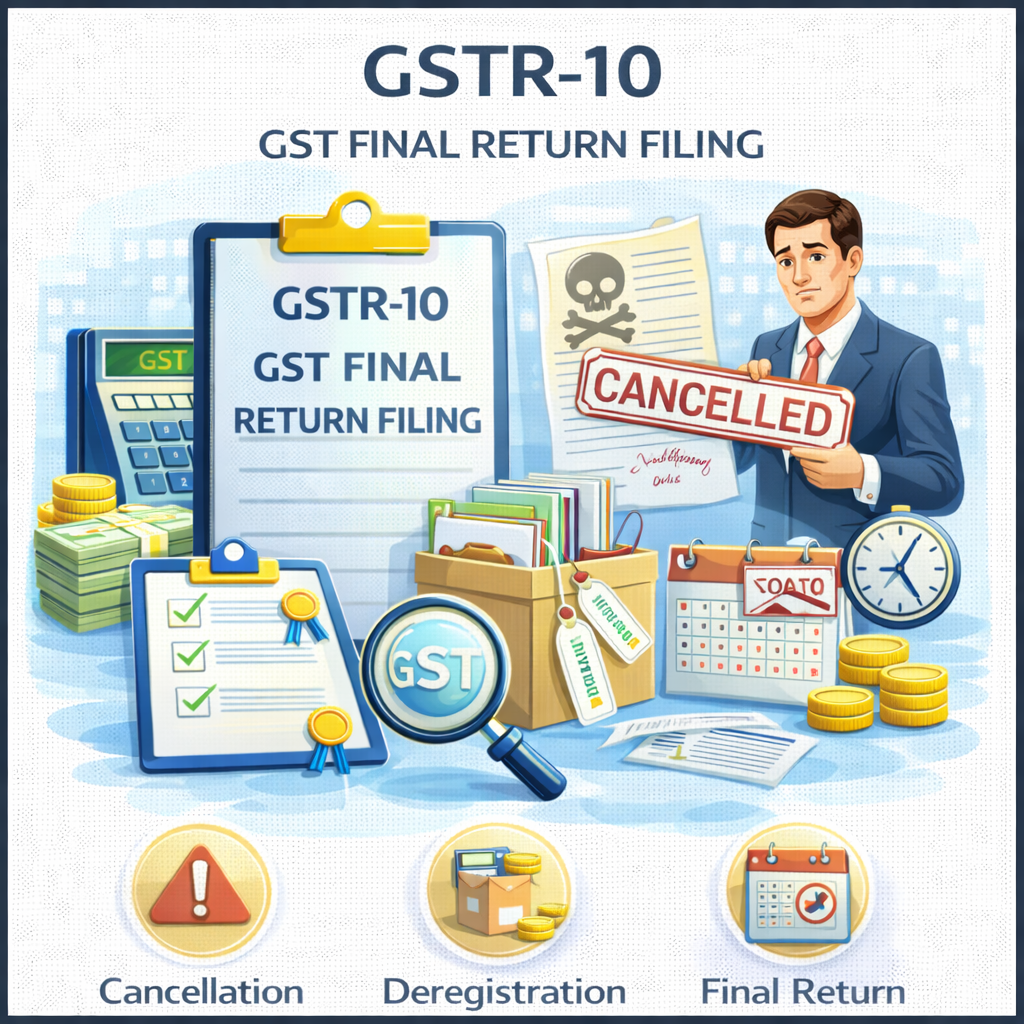
Every
taxpayer whose GST registration has been cancelled or voluntarily surrendered
is required to file GSTR-10, also known as the Final Return. This
obligation applies regardless of whether any business transactions were carried
out between the date of cancellation and the date of filing the return. Even if
there were no sales, purchases, or tax liabilities during this period, filing
GSTR-10 is mandatory to formally close GST compliance. Failure to submit the
return within the prescribed time may result in late fees and penalties, making
timely filing essential for proper closure of registration.
To
file GSTR-10 (Final Return) after
cancellation or surrender of GST registration, the following information and
documents must be provided:
Basic Details:
- Name
of the taxpayer
- Registered
address
- GSTIN
Cancellation details:
- Application
Reference Number (ARN) of the cancellation/surrender application
- Effective
date of cancellation
- Unique
ID of the cancellation order (if issued by authorities)
- Copy
of the GST registration cancellation order/letter
Stock & ITC Detail:
- Details
of inputs, semi-finished goods, finished goods, and capital goods held on the
date of cancellation
- Input
Tax Credit (ITC) availed on such stock
- GST
liability payable on closing stock
- Details
of any outstanding tax dues
Payment & Refund Information:
- Copies
of GST payment challans (if tax is payable)
- Bank
account details for processing any eligible refund
Other Supporting Documents:
- Any
additional documents required by the GST department for verification
Accurate
submission ensures smooth closure of GST registration and avoids penalties.
GSTR-10, also known as the Final Return, must be filed
by taxpayers whose GST registration has been cancelled or voluntarily
surrendered. Filing this return offers several important advantages:
- Submitting
GSTR-10 is a mandatory requirement under GST law. Failure to file within the
prescribed time can result in late fees and legal consequences.
- Timely
filing helps prevent additional financial burdens. Delays may attract a late
fee of ₹100 per day (subject to prescribed limits), along with possible
penalties.
- Filing
GSTR-10 formally completes the cancellation process and ensures that all tax
liabilities are properly settled, preventing future compliance issues.
- It
allows taxpayers to declare and adjust any pending Input Tax Credit or tax
liabilities related to stock held at the time of cancellation.
- Timely
submission helps maintain a strong compliance track record, which is beneficial
for future registrations or business credibility.
Related Services


Why Choose Arthtattava
Expert-Led Financial Solutions: Our team combines deep domain expertise with practical experience across industries.
End-to-End Accounting Support: From bookkeeping to reporting, we manage complete financial operations seamlessly.
Technology-Driven Approach: We leverage advanced tools like Tally, OCR, and automation for accuracy.
Customized Business Solutions: Every service is tailored to your business needs, scale, and growth stage.
Data Accuracy & Compliance Focus: We ensure error-free records while strictly adhering to regulatory requirements.
Reliable & Timely Delivery: Consistent turnaround times with proactive communication to support business decisions.
Know More Details