
×
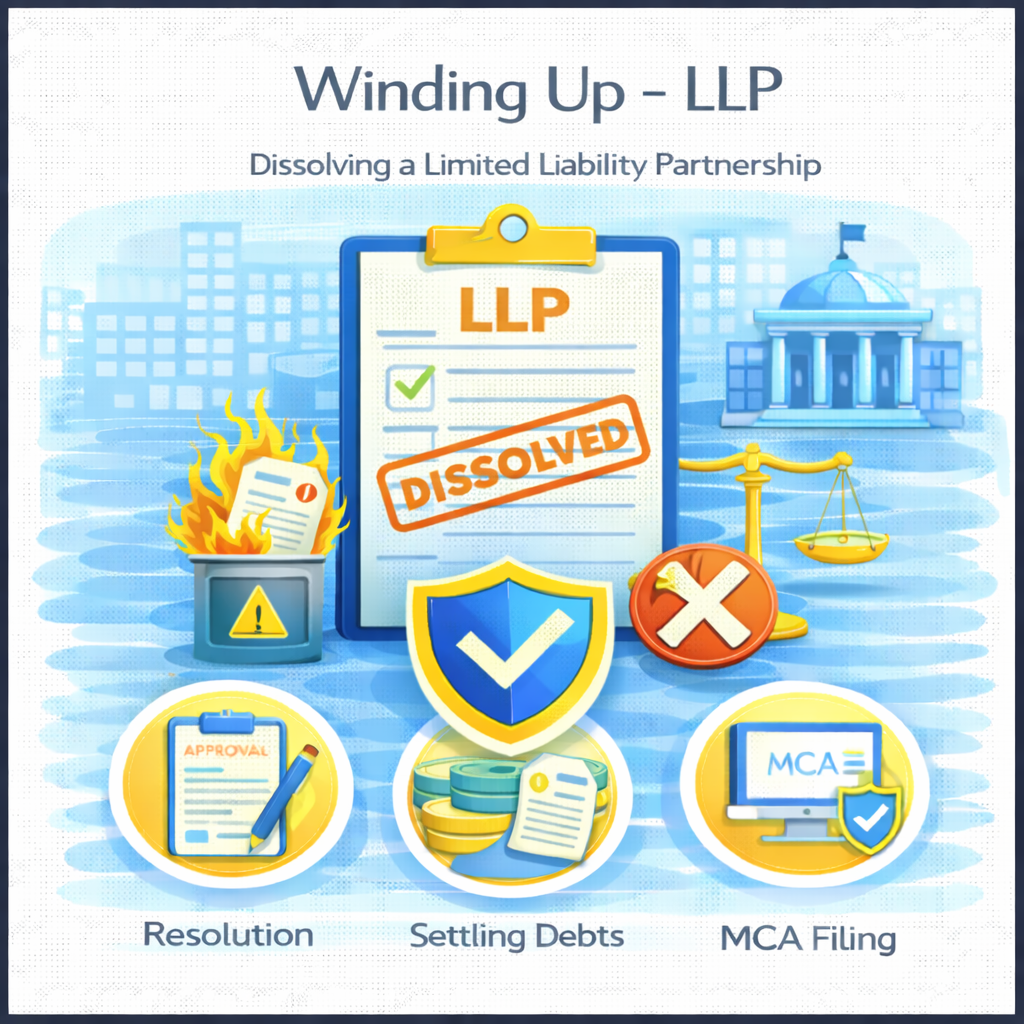
Winding up a Limited Liability Partnership (LLP) refers to the legal process of closing the LLP by settling its liabilities, disposing of its assets, and distributing any remaining funds among the partners according to the LLP agreement. It marks the formal end of the LLP’s business operations and legal existence.
The winding-up process can be initiated voluntarily by the partners when they decide to discontinue the business, or compulsorily by a Tribunal in situations such as insolvency, prolonged inactivity, or violation of legal provisions. During this process, the LLP must clear all outstanding debts, fulfill statutory obligations, and ensure proper distribution of remaining assets.
Winding up an LLP requires careful compliance with legal procedures and regulatory requirements under the applicable laws. Proper financial documentation, settlement of liabilities, and adherence to prescribed filing procedures are essential to complete the process smoothly.
Partners of the LLP must handle the process systematically to ensure transparency and fairness. A well-managed winding-up process helps protect the interests of creditors, partners, and other stakeholders while ensuring that the LLP is dissolved in a legally compliant manner.
A Limited
Liability Partnership (LLP) can be wound up through different methods, each
involving specific procedures and legal consequences.
- Voluntary
Winding Up: In
voluntary winding up, the partners of the LLP mutually decide to close the
business and wind up its affairs. This decision is generally taken through the
consent of the partners and may also be based on conditions mentioned in the
LLP agreement. The partners settle the LLP’s liabilities, dispose of assets,
and distribute the remaining funds among themselves before dissolving the
entity.
- Winding
Up under the Insolvency and Bankruptcy Code (IBC), 2016: Under the Insolvency and Bankruptcy Code, 2016,
LLPs facing financial distress may undergo insolvency proceedings aimed at
restructuring or resolving their financial issues. If revival or resolution is
not possible, the National Company Law Tribunal (NCLT) may order the
liquidation of the LLP, leading to the winding up of the entity.
- Compulsory
Winding Up by the Tribunal: In this method, the LLP is wound up by an order of the
Tribunal rather than by the decision of the partners. The Tribunal may initiate
winding up for reasons such as the LLP’s inability to pay its debts, failure to
comply with statutory requirements, involvement in unlawful activities, or any
other grounds considered appropriate under the law.
The
following documents are generally required for the winding up or closure of a
Limited Liability Partnership (LLP):
- LLP Agreement –
A copy of the LLP agreement and any amendments made to it.
- Partners’ Resolution – Consent or resolution passed by all partners
agreeing to wind up the LLP.
- Statement of Accounts – A statement showing the LLP’s assets and
liabilities, usually certified by a Chartered Accountant.
- Affidavit and Declaration – A declaration by designated partners stating
that the LLP has no liabilities or that all liabilities have been settled.
- Income Tax Return Acknowledgement – Copy of the latest filed income tax return of
the LLP.
- Consent of Creditors (if applicable) – No objection certificate from creditors
confirming that all dues have been cleared.
- Indemnity Bond –
A bond from designated partners undertaking responsibility for any future
liabilities.
- Form 24 –
Application filed with the Registrar of Companies (ROC) for striking off the
LLP name from the register.
- Bank Account Closure Proof – Evidence showing that the LLP’s bank account
has been closed.
- PAN Card of the LLP – Copy of the LLP’s Permanent Account Number
card.
These
documents help ensure that the LLP is closed in compliance with legal and
regulatory requirements.
Related Services


Why Choose Arthtattava
Expert-Led Financial Solutions: Our team combines deep domain expertise with practical experience across industries.
End-to-End Accounting Support: From bookkeeping to reporting, we manage complete financial operations seamlessly.
Technology-Driven Approach: We leverage advanced tools like Tally, OCR, and automation for accuracy.
Customized Business Solutions: Every service is tailored to your business needs, scale, and growth stage.
Data Accuracy & Compliance Focus: We ensure error-free records while strictly adhering to regulatory requirements.
Reliable & Timely Delivery: Consistent turnaround times with proactive communication to support business decisions.
Know More Details