
×
Management Information System (MIS) Reporting is a process that helps you organize and present important business data in a structured format for management review and decision-making. MIS reports typically summarize financial and operational information such as sales performance, expenses, profitability, receivables, payables, inventory levels, and cash flow. These reports provide a clear overview of your business performance over a specific period.
By analyzing MIS reports, you can identify patterns, monitor financial health, evaluate operational efficiency, and detect potential issues early. MIS reporting also helps you track key performance indicators and compare actual results with business targets. This enables you to make timely strategic decisions and improve overall business performance.
With proper MIS reporting support, you can maintain accurate business data, prepare regular management reports, and present meaningful insights to stakeholders. A well-prepared MIS report not only improves transparency but also supports better planning, budgeting, and performance monitoring within your organization.
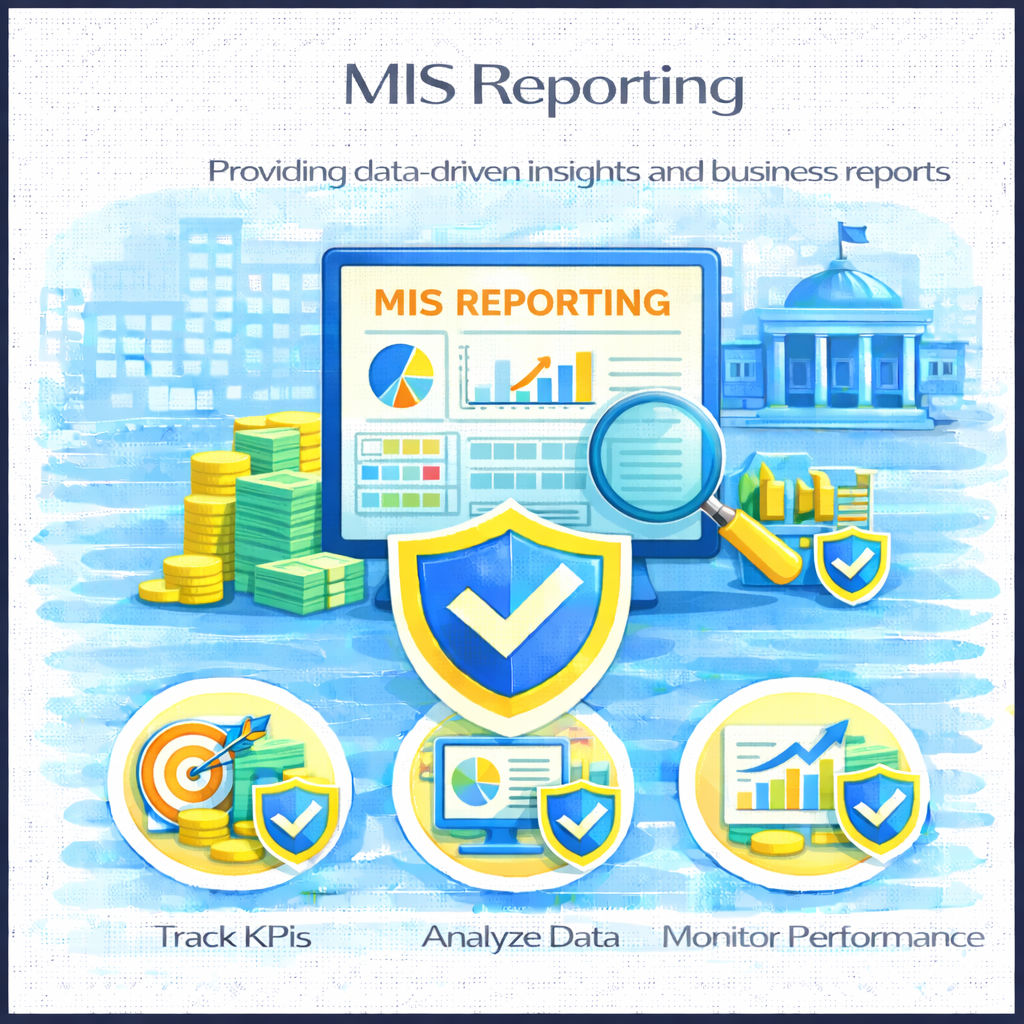
Our MIS Reporting service helps you convert your financial and operational data into meaningful reports that support better business decision-making. The service focuses on collecting business data, organizing financial information, and preparing structured reports that highlight important performance indicators.
You receive assistance in preparing periodic MIS reports such as financial summaries, profitability analysis, expense tracking, and performance dashboards. These reports help you understand the financial position of your business and provide insights that support effective management and strategic planning.
MIS reporting can include different types of reports depending on the business requirements.
-
Financial MIS Reports – Summaries of revenue, expenses, profitability, and cash flow.
-
Sales MIS Reports – Analysis of sales performance, customer trends, and revenue growth.
-
Operational MIS Reports – Reports related to production, inventory, or operational efficiency.
-
Budget and Variance Reports – Comparison of actual performance against planned budgets.
To prepare accurate MIS reports, certain financial and operational records are required.
-
Accounting records and financial statements.
-
Sales and purchase data related to business transactions.
-
Expense records and payment details.
-
Bank statements and cash flow information.
-
Inventory records, if applicable.
-
Receivables and payables reports.
-
Any additional operational data required for performance analysis.
Preparing MIS reports involves collecting relevant data and organizing it into meaningful business reports.
-
The process begins with understanding your business operations and reporting requirements to determine the type of MIS reports needed.
-
Relevant financial and operational data is collected from accounting records and business systems.
-
The collected data is analyzed and organized into structured report formats for easier interpretation.
-
Key business indicators such as revenue, expenses, profitability, and operational metrics are evaluated.
-
MIS reports are prepared with charts, summaries, and performance insights to provide a clear overview of business performance.
-
The reports are reviewed for accuracy and consistency with financial records.
-
The final MIS reports are shared periodically for management review and decision-making.
While MIS reporting is primarily a management tool, certain best practices help ensure that the reports remain accurate and reliable.
-
Financial data used in MIS reports should be accurate and consistent with accounting records.
-
Business transactions must be recorded properly in the accounting system.
-
Reports should be prepared regularly to maintain updated business insights.
-
Internal review processes should be followed to verify the accuracy of reported information.
-
Confidential business information should be handled securely and shared only with authorized personnel.
Related Services


Why Choose Arthtattava
Expert-Led Financial Solutions: Our team combines deep domain expertise with practical experience across industries.
End-to-End Accounting Support: From bookkeeping to reporting, we manage complete financial operations seamlessly.
Technology-Driven Approach: We leverage advanced tools like Tally, OCR, and automation for accuracy.
Customized Business Solutions: Every service is tailored to your business needs, scale, and growth stage.
Data Accuracy & Compliance Focus: We ensure error-free records while strictly adhering to regulatory requirements.
Reliable & Timely Delivery: Consistent turnaround times with proactive communication to support business decisions.
Know More Details