
×
The term “winding up”, as defined under Section 2(94A) of the Companies Act, 2013, refers to the legal process of closing a company through procedures specified under the Companies Act or through liquidation under the Insolvency and Bankruptcy Code, 2016 (IBC). It is a formal mechanism through which a company ends its operations and settles its financial and legal obligations before being dissolved.
During the winding-up process, the company stops carrying out its normal business activities. A liquidator is usually appointed to take control of the company’s assets and manage the process. The liquidator identifies and sells the company’s assets, collects any outstanding receivables, and uses the proceeds to pay off creditors, lenders, and other liabilities in accordance with the prescribed legal order of priority. After all debts and obligations have been settled, any remaining surplus is distributed among the company’s shareholders based on their shareholding.
Although the company ceases its regular operations during this phase, it continues to exist as a separate legal entity until the process is fully completed. This allows the company to initiate or defend legal proceedings before the Tribunal or relevant authorities if necessary.
The main objective of winding up is to ensure an orderly and transparent closure of the company while protecting the interests of creditors, shareholders, and other stakeholders before the company is formally dissolved.
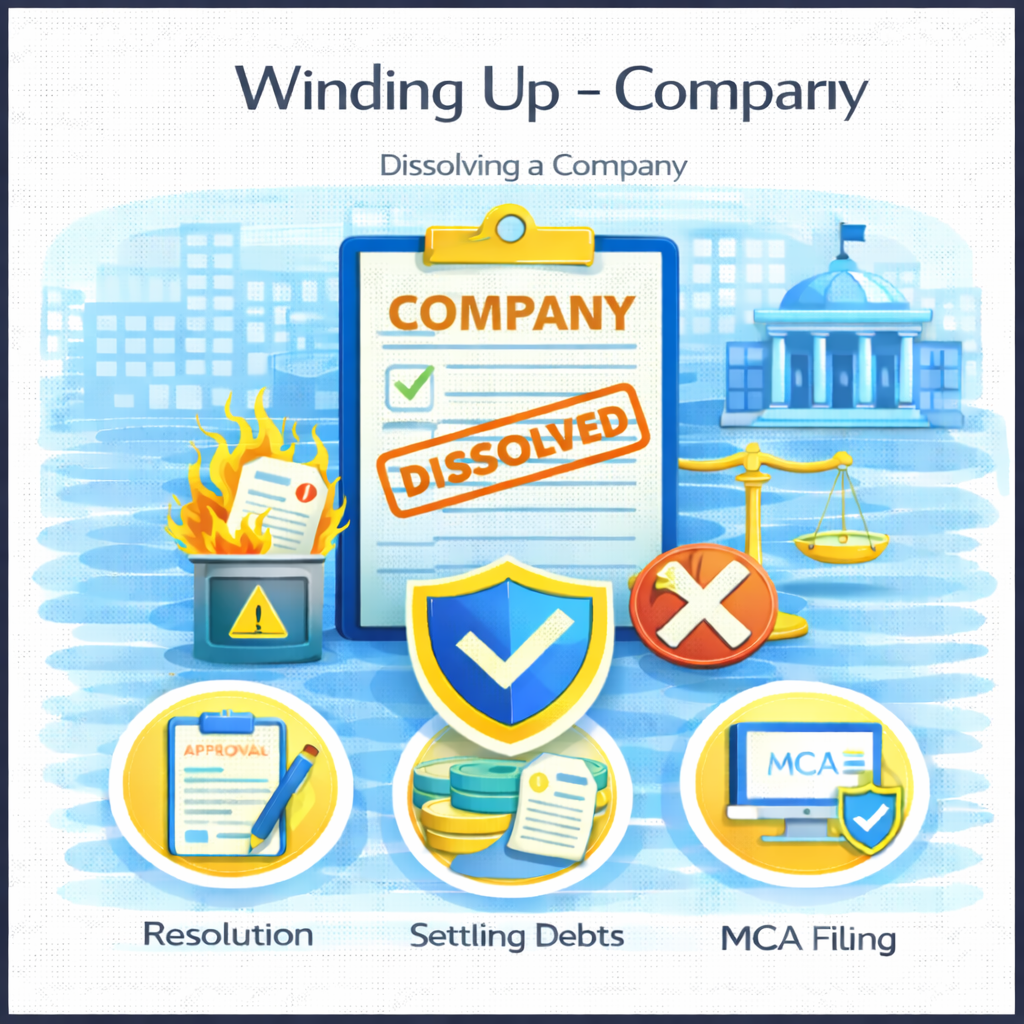
Winding Up - Company
In Stock
₹0
0%
Off
Verification Documents Required
- Memorandum of Association (Existing MOA)
- Articles of Association (AOA) (Existing AOA)
- Board Resolution Copy (Board Resolution)
Under
Section 293 of the Companies Act, the winding up of a company can take
place through three main methods, depending on the circumstances and the
financial condition of the company.
- Compulsory
Winding Up by the Court: Compulsory
winding up occurs when a court orders the dissolution of a company. This
typically happens when the company is unable to pay its debts, violates
statutory requirements, or when the court believes that winding up the company
is just and equitable. In such cases, the court appoints an official liquidator
who takes charge of the company’s affairs. The liquidator is responsible for
collecting and selling the company’s assets, settling liabilities with
creditors, and distributing any remaining funds to shareholders according to their
rights.
- Voluntary
Winding Up: Voluntary
winding up takes place when the company itself decides to close its operations.
This decision is made through a resolution passed by the members or creditors
of the company. If the company is financially solvent and capable of paying its
debts, the members initiate the process. However, if the company is unable to
meet its financial obligations, the creditors may initiate the winding-up
process. A liquidator is appointed to manage the process without direct court
involvement.
- Winding
Up Subject to the Supervision of the Court: In
this method, the winding-up process begins voluntarily but is carried out under
the supervision of the court. The court may monitor the proceedings to ensure
transparency and protect the interests of creditors, shareholders, and other
stakeholders.
For
the voluntary winding up of a
company, several important documents must be prepared and
submitted to ensure that the process is carried out in a lawful and transparent
manner. These documents help verify the company’s financial position and
support the formal closure of the business.
- Special
Resolution (Form-26): A
resolution passed by the shareholders confirming the company’s decision to wind
up its operations.
- Declaration
of Solvency (Form 107): A
formal declaration stating that the company is capable of paying all its debts
within the prescribed time period.
- Directors’
Affidavit: A
sworn statement by the directors confirming the accuracy of financial documents
such as the auditor’s report and the latest financial statements.
- Liquidator’s
Consent:
Written consent from the appointed liquidator agreeing to carry out the
winding-up process.
- Notice
of Winding Up Resolution: A
public notice published in the Official Gazette announcing the company’s
decision to wind up.
- Notice
of Appointment of Liquidator: A
notice published in the Official Gazette informing about the appointment of the
liquidator.
- Preliminary
Liquidator’s Report: An
initial report submitted by the liquidator outlining the plan and progress of
the winding-up process.
- Final
Liquidator’s Report and Accounts: A
detailed final report and financial statement presented at the final meeting of
shareholders.
- Notice
of Final Meeting: An
announcement informing stakeholders about the final meeting of the company.
- Return
of Meeting:
Documents containing the final report, accounts, and meeting minutes filed with
the Registrar of Companies.
Related Services


Why Choose Arthtattava
Expert-Led Financial Solutions: Our team combines deep domain expertise with practical experience across industries.
End-to-End Accounting Support: From bookkeeping to reporting, we manage complete financial operations seamlessly.
Technology-Driven Approach: We leverage advanced tools like Tally, OCR, and automation for accuracy.
Customized Business Solutions: Every service is tailored to your business needs, scale, and growth stage.
Data Accuracy & Compliance Focus: We ensure error-free records while strictly adhering to regulatory requirements.
Reliable & Timely Delivery: Consistent turnaround times with proactive communication to support business decisions.
Know More Details