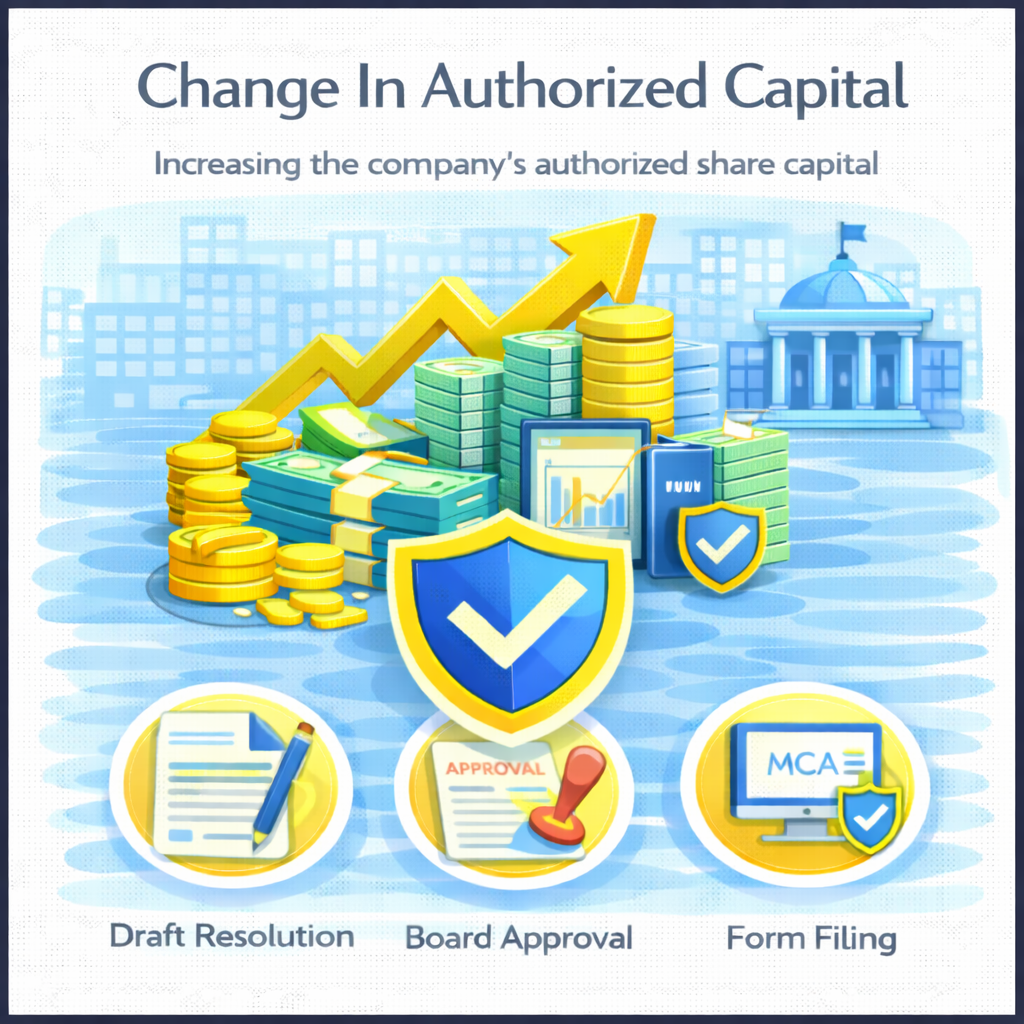
To formalize the increase in authorised share capital, certain documents must be prepared and submitted as part of the regulatory filing process.
-
A copy of the latest Memorandum of Association (MOA) reflecting the amended authorised capital clause.
-
The most recent Articles of Association (AOA) of the company, particularly if any amendments have been made.
-
A certified copy of the ordinary resolution passed by the shareholders approving the increase in authorised share capital.
-
A copy of the notice issued for the Extraordinary General Meeting along with the explanatory statement.
-
Minutes of the Extraordinary General Meeting where the resolution for increasing authorised capital was approved.
-
The relevant regulatory filing form submitted to the Registrar along with supporting documents
Increasing the authorised share capital of a company involves a structured procedure that ensures proper approvals and regulatory compliance. The process generally includes reviewing the company’s governing documents, obtaining approvals from the board and shareholders, and filing the required forms with the relevant authority.
-
The first step is to review the Articles of Association (AOA) to confirm whether it allows the company to increase its authorised share capital. If the AOA already contains such a provision, the company can proceed with the process. If not, the AOA must first be amended to include the necessary provision for altering the authorised capital.
-
The company must then convene a Board of Directors meeting by issuing a notice to all directors along with the agenda. During the meeting, the board reviews the proposal to increase the authorised capital and passes a resolution approving the proposal. The board also decides to call an Extraordinary General Meeting (EGM) of shareholders and approves the notice for the meeting.
-
A notice of the Extraordinary General Meeting is issued to shareholders and other eligible participants specifying the date, time, and venue of the meeting along with details of the proposed increase in authorised share capital.
-
During the Extraordinary General Meeting, the proposal to increase the authorised share capital is presented to the shareholders. An ordinary resolution is passed approving the increase and the corresponding amendment to the capital clause of the Memorandum of Association.
-
After shareholder approval, the company must file the prescribed form with the Registrar within the specified time period along with the required documents. Once the filing is completed, the authorised share capital of the company stands increased as per the approved resolution
After the shareholders approve the increase in authorised share capital, the company must complete certain regulatory filings and procedural updates to ensure legal compliance. These filings must be completed within the prescribed time frame along with the required documents and applicable fees.
-
The first compliance requirement is the filing of Form MGT-14 with the Registrar within 30 days of passing the relevant resolution. This form records the shareholder resolution approving the change in authorised share capital. The filing generally includes company details such as the Corporate Identification Number, purpose of the filing, dates of notice and resolution, and the resolution details along with the required digital signatures. Supporting documents typically include the notice of the general meeting with an explanatory statement, a certified copy of the resolution passed by shareholders, and the updated Memorandum of Association reflecting the revised capital clause.
-
The company must then file Form SH-7 with the Registrar to officially notify the authority about the increase in authorised share capital. This filing contains details such as the company’s identification information, type of resolution passed, meeting date, previous and revised authorised capital amounts, and a breakdown of the additional share capital. The form must be submitted along with supporting documents including the certified resolution for capital alteration, the updated Memorandum of Association, and the Articles of Association if it includes provisions related to the authorised capital increase.
-
The company is also required to pay the applicable e-stamp duty and filing fees through the regulatory portal based on the increased authorised capital amount. This payment is mandatory for completing the registration of the capital increase.
-
After the filings are completed, the company must update all official copies of the Memorandum of Association and Articles of Association to reflect the revised authorised share capital. This ensures that the company’s constitutional documents remain accurate and consistent.
-
Once the authorised capital is increased, the company may proceed with allotment of additional shares to existing or new shareholders. This allows the company to raise additional funds and increase its paid-up share capital.
Failure to follow the prescribed procedures or delays in filing the required forms may result in penalties under the applicable provisions of company law. Therefore, companies must ensure that all filings, documentation, and updates are completed within the stipulated time to maintain compliance