
×
Form DPT-3 is an annual compliance requirement under the Companies (Acceptance of Deposits) Rules, 2014, applicable to all companies other than government companies. The form must be filed with the MCA by 30th June every year and includes details of outstanding deposits, loans, and other receipts of money that are not treated as deposits as of 31st March. The return is required to be duly audited by the company’s statutory auditor to ensure accuracy and regulatory compliance. The requirement originated from the Companies (Acceptance of Deposits) Amendment Rules, 2019, introduced by the Central Government in consultation with the Reserve Bank of India to protect the interests of creditors and depositors. As per the amendment and MCA notification dated 22nd January 2019, companies were initially required to file a one-time return for outstanding amounts not considered deposits from 1st April 2014 to 31st March 2019, followed by mandatory annual filing thereafter. Non-compliance may attract additional fees and penalties, making timely submission essential for maintaining statutory compliance.
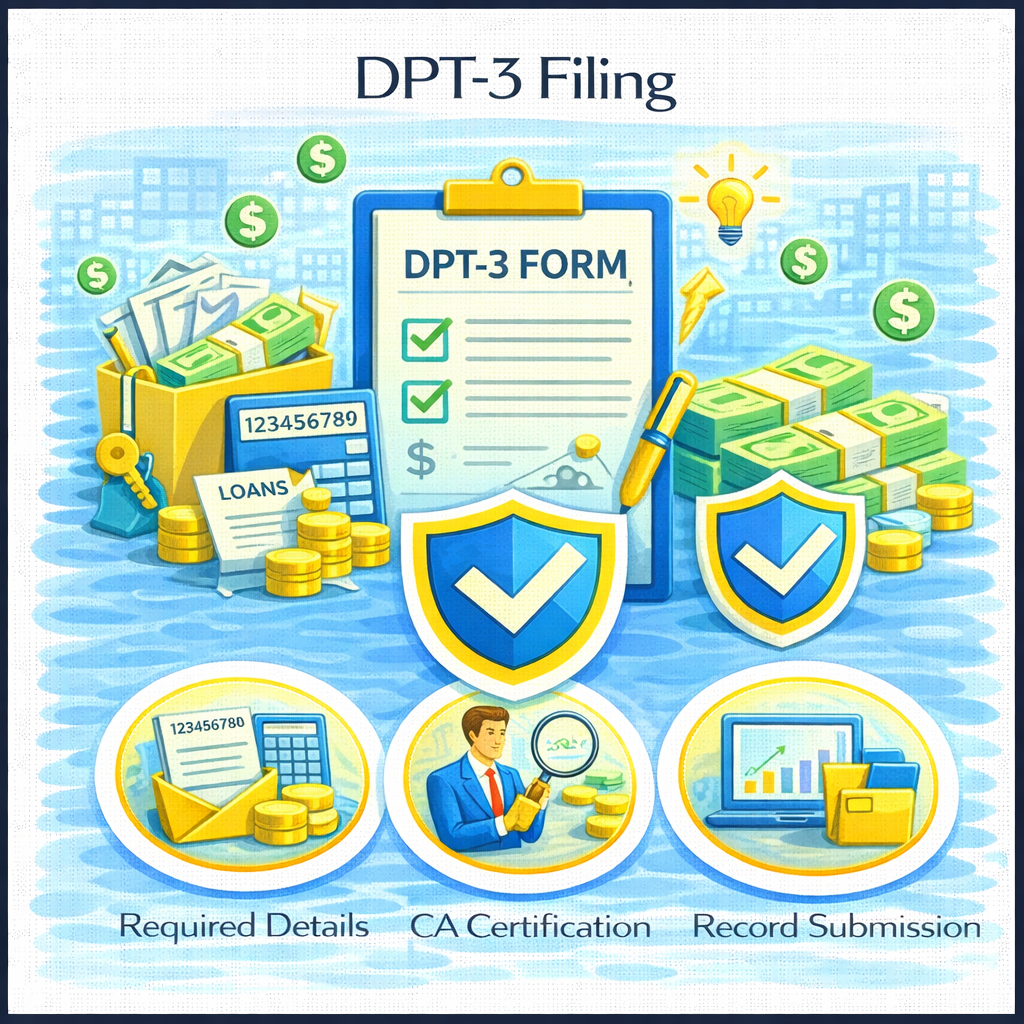
Form DPT-3 is required to be filed by all companies, except those specifically exempted under the Companies Act, 2013 and the Companies (Acceptance of Deposits) Rules, 2014. The following companies are required to file Form DPT-3:
Private Limited Companies, Public Limited Companies, One Person Companies (OPCs), Small Companies, and Non-Small Companies must file DPT-3 annually if they have outstanding deposits, loans, or amounts received that are not treated as deposits as on 31st March of the relevant financial year.
Filing is mandatory even if the company has received loans from related entities such as a Holding Company, Subsidiary Company, or Associate Company. Any outstanding amount received from these entities that falls within the reporting requirements must be disclosed in Form DPT-3.
However, certain companies are exempt from filing Form DPT-3. Government Companies are not required to file this return. Additionally, Banking Companies regulated by the Reserve Bank of India (RBI), Non-Banking Financial Companies (NBFCs) registered with the RBI, Housing Finance Companies registered with the National Housing Bank (NHB), and other companies specifically notified by the Ministry of Corporate Affairs (MCA) under Section 73 of the Act are exempt from this requirement.
Companies must carefully assess their financial transactions to determine applicability and ensure timely compliance to avoid penalties
Form DPT-3 is applicable to all companies, except those specifically exempted, that have received or hold outstanding amounts as on 31st March of the relevant financial year. Filing is mandatory if the company has received deposits from members or directors, loans from third parties, or advances for goods or services, whether secured or unsecured. The form covers a wide range of financial transactions, including secured debts backed by collateral, unsecured debts without security, external borrowings from banks or financial institutions, and commercial borrowings raised for business purposes.
However, certain receipts are not treated as deposits for the purpose of DPT-3 reporting. These include share capital received from shareholders, debentures issued by the company, advances received against confirmed orders, funds received from the Central or State Government, loans from banks and financial institutions, inter-company loans, subscription money received in advance for securities, and employee security deposits not exceeding their annual salary.
Companies must evaluate all outstanding financial transactions carefully to determine whether Form DPT-3 filing is applicable and ensure compliance within the prescribed timeline
To ensure accurate and compliant filing of Form DPT-3, the following documents are generally required:
Auditor’s Certificate
A mandatory certificate from the company’s statutory auditor confirming the correctness of the details reported in Form DPT-3, including deposits and outstanding receipts.
Trust Deed (If Applicable)
If the company has created a trust for securing deposits, a copy of the executed trust deed must be attached.
Instrument Creating Charge (If Applicable)
Where deposits are secured by creating a charge on company assets, a copy of the instrument evidencing such charge must be submitted.
Details of Liquid Assets (If Applicable)
Supporting documents reflecting the company’s liquid assets, which may be required for reporting purposes under the Deposit Rules.
List of Depositors (If Required)
In certain cases, based on the nature and amount of deposits, the MCA may require a detailed list of depositors along with relevant particulars.
Proper documentation ensures smooth processing of Form DPT-3 and helps maintain full regulatory compliance
Form DPT-3 is a web-based return that must be filed online through the Ministry of Corporate Affairs (MCA) portal. The entire process is completed electronically and requires accurate disclosure of financial details along with mandatory attachments.
Step 1: Login to the MCA Portal: Visit the official MCA website and log in using your registered Business User credentials. If not already registered, create an account to access e-filing services.
Step 2: Access the DPT-3 Webform: After logging in, navigate to MCA Services and select Deposit Related Filings. Choose the DPT-3 webform to begin the online filing process.
Step 3: Fill in Company and Financial Details: Provide accurate and updated information, including the Company’s Corporate Identification Number (CIN), registered email ID, principal business objects, and net worth as per the latest financial statements. You must also disclose particulars of any charge created, total outstanding amounts as on 31st March of the relevant financial year, and credit rating details (if applicable). Ensure that all figures reported match audited financial records.
Step 4: Attach Supporting Documents: Upload the required attachments in digital format, including the auditor’s certificate and any other applicable supporting documents as prescribed under the Deposit Rules.
Step 5: Submit the Form and Generate SRN: Once the form is completed and documents are attached, submit it online. Upon successful submission, a Service Request Number (SRN) will be generated for tracking purposes.
Step 6: Affix Digital Signature and Pay Filing Fee: Authenticate the form using the Digital Signature Certificate (DSC) of the authorised signatory. Pay the prescribed filing fee, which is calculated based on the company’s nominal or paid-up share capital.
Step 7: Receive Acknowledgement: After successful submission and payment, an acknowledgement email confirming receipt of the return will be sent to the company’s registered email ID.
Timely completion of the DPT-3 filing process ensures statutory compliance and helps avoid additional fees or penalties under the Companies Act, 2013.Form DPT-3 must be filed annually with the Ministry of Corporate Affairs (MCA) on or before 30th June of every year. This compliance requirement applies to all companies that are required to report deposits, outstanding loans, or amounts received that are not treated as deposits as on 31st March of the relevant financial year.
In India, the financial year runs from 1st April to 31st March, and companies must disclose all applicable outstanding receipts and deposits relating to that financial year in Form DPT-3. The return for a financial year ending on 31st March must be filed by 30th June immediately following the close of that year.
Timely filing is essential to avoid additional fees and penalties under the Companies Act, 2013 and the Companies (Acceptance of Deposits) Rules, 2014.
Under the Companies Act, 2013, failure to file Form DPT-3 or any default in complying with the prescribed requirements may attract penalties for both the company and its officers in default. The company may be liable to a fine which can extend up to ₹5,000. Additionally, officers responsible for the default may also be subject to a fine of up to ₹5,000 each. In cases where the contravention continues beyond the initial default, a further penalty of up to ₹500 per day may be imposed for every day the default continues.
These provisions are designed to ensure strict adherence to statutory filing requirements. Timely and accurate filing of Form DPT-3 is essential to avoid financial penalties and maintain full compliance with the Companies Act, 2013.
Related Services


Why Choose Arthtattava
Expert-Led Financial Solutions: Our team combines deep domain expertise with practical experience across industries.
End-to-End Accounting Support: From bookkeeping to reporting, we manage complete financial operations seamlessly.
Technology-Driven Approach: We leverage advanced tools like Tally, OCR, and automation for accuracy.
Customized Business Solutions: Every service is tailored to your business needs, scale, and growth stage.
Data Accuracy & Compliance Focus: We ensure error-free records while strictly adhering to regulatory requirements.
Reliable & Timely Delivery: Consistent turnaround times with proactive communication to support business decisions.
Know More Details