
×
Employees’ State Insurance (ESI) is a comprehensive social security scheme aimed at providing financial protection and medical benefits to employees during unforeseen circumstances. Funded through contributions from both employers and employees, the scheme ensures access to quality healthcare services for insured persons and their dependents.
ESI offers a wide range of benefits, including
medical care, sickness benefits, maternity benefits, and compensation for
employment-related injuries or disabilities. It also provides financial
assistance for funeral expenses and confinement costs. In the unfortunate event
of an employee’s death due to a work-related injury or occupational illness,
the scheme extends financial support to the dependent family members. Overall,
ESI plays a vital role in safeguarding the socio-economic security and
well-being of employees and their families.
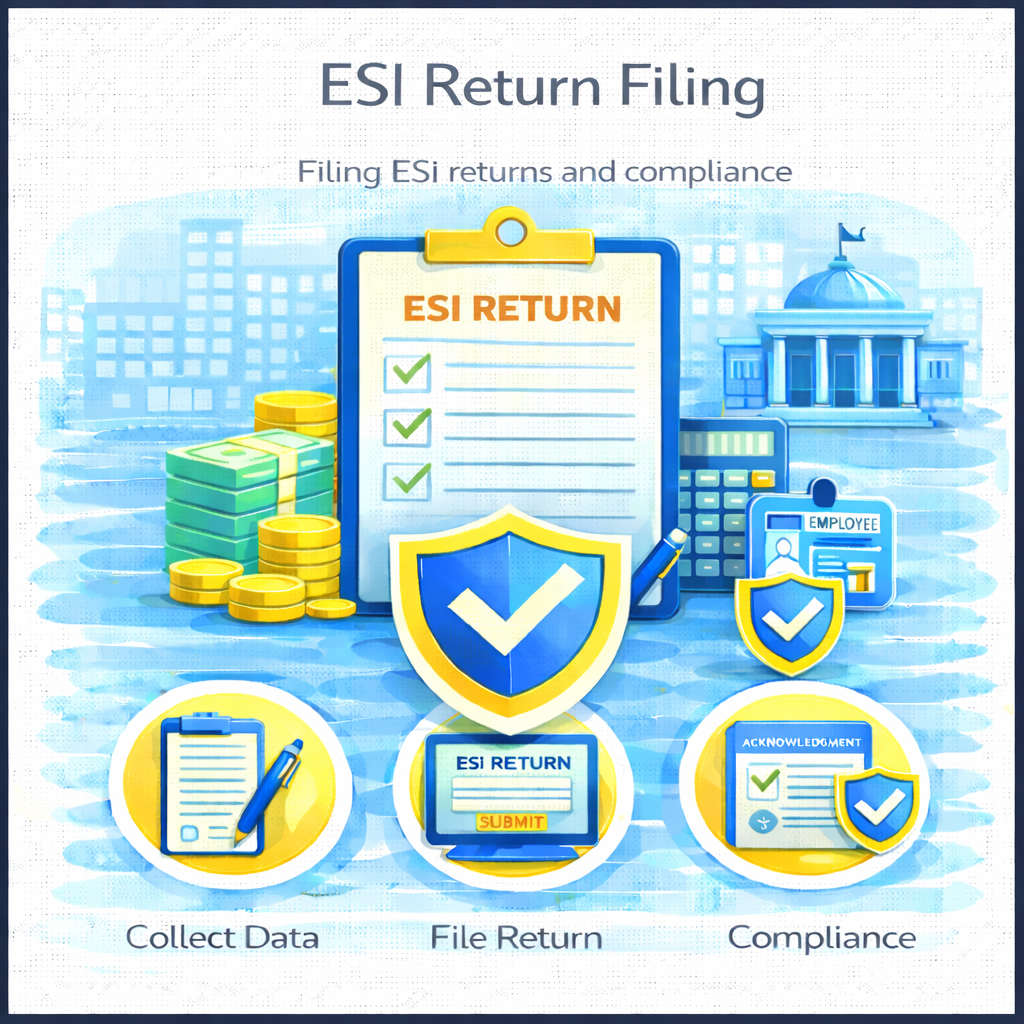
Filing
of Employees’ State Insurance (ESI) returns is mandatory for establishments
covered under the Employees’ State Insurance
Act, 1948. The following entities are required to file ESI
returns:
Establishments covered under the ESI Act:
- Businesses
employing 10 or more employees (in most
states; the threshold may vary in certain states).
- Applicable
to factories, shops, hotels, restaurants, road transport establishments,
cinemas, private educational institutions, and other notified establishments.
Wage eligibility Of Employees:
- Employees
earning gross wages up to ₹21,000 per month
(₹25,000 for persons with disabilities) are covered under the ESI scheme.
- Employers
must include all eligible employees in contribution records and return filings.
Registered Establishment with ESIC:
- Once
an establishment obtains ESI registration (ESIC code number), it is legally
required to file half-yearly ESI returns,
even if there are no contributions for a particular period (Nil return, if
applicable).
Contribution Compliance:
- Employers
must deposit both employer and employee contributions within the prescribed due
date and reflect the same in return filings.
Timely
and accurate ESI return filing ensures statutory compliance and uninterrupted
access to medical and financial benefits for eligible employees.
To
ensure accurate and compliant Employees’ State Insurance (ESI) return filing,
businesses should maintain the following documents and records in an updated
and readily accessible manner:
- Attendance
Register:
Record of employee attendance for calculating eligible wages and contributions.
- Form
6 (ESI Register):
Consolidated record of employees covered under the ESI scheme.
- Register
of Wages:
Detailed wage register reflecting gross wages, deductions, and ESI
contributions.
- Accident
Register:
Documentation of workplace accidents and related details, if any.
- Cancelled
Cheque of the Company:
For verification of bank account details.
- Inspection
Book:
Maintained for remarks and observations by ESI authorities during inspections.
- PAN
Card of the Organization:
Proof of the company’s tax identity.
- Monthly
ESI Challans and Return Copies:
Evidence of contribution payments and filings made with ESIC.
Maintaining
these records ensures smooth return filing, easier inspections, and continued
compliance with ESI regulations.
Filing
ESI returns provides several important advantages for both employers and
employees under the Employees’ State Insurance (ESI) scheme:
- Statutory
Compliance:
Timely filing ensures adherence to the provisions of the ESI Act, helping
employers avoid penalties, interest, and legal consequences arising from
non-compliance.
- Accurate
Record Maintenance:
Regular return filing creates an official and systematic record of employee
wages and contributions, which is useful during inspections, audits, or clarifications.
- Employee
Benefit Eligibility:
Proper filing validates employees’ eligibility to receive benefits such as
medical care, maternity benefits, sickness benefits, disability compensation,
and dependent benefits.
- Transparency
and Accountability:
Consistent reporting promotes transparency in contribution management,
strengthening trust between employers and employees.
- Dispute
Resolution Support: Filed
returns serve as reliable documentation in case of discrepancies or disputes
regarding contributions or benefit claims.
- Smooth
Claim Processing:
Accurate and timely submissions facilitate faster processing of employee
claims, ensuring uninterrupted access to entitled benefits.
- Enhanced
Business Credibility:
Regular compliance reflects positively on an organization’s governance
standards and financial discipline.
- Data
Accuracy and Updates:
Return filing allows employers to correct errors or update employee details,
ensuring ESI records remain accurate and up to date.
Related Services


Why Choose Arthtattava
Expert-Led Financial Solutions: Our team combines deep domain expertise with practical experience across industries.
End-to-End Accounting Support: From bookkeeping to reporting, we manage complete financial operations seamlessly.
Technology-Driven Approach: We leverage advanced tools like Tally, OCR, and automation for accuracy.
Customized Business Solutions: Every service is tailored to your business needs, scale, and growth stage.
Data Accuracy & Compliance Focus: We ensure error-free records while strictly adhering to regulatory requirements.
Reliable & Timely Delivery: Consistent turnaround times with proactive communication to support business decisions.
Know More Details