
×
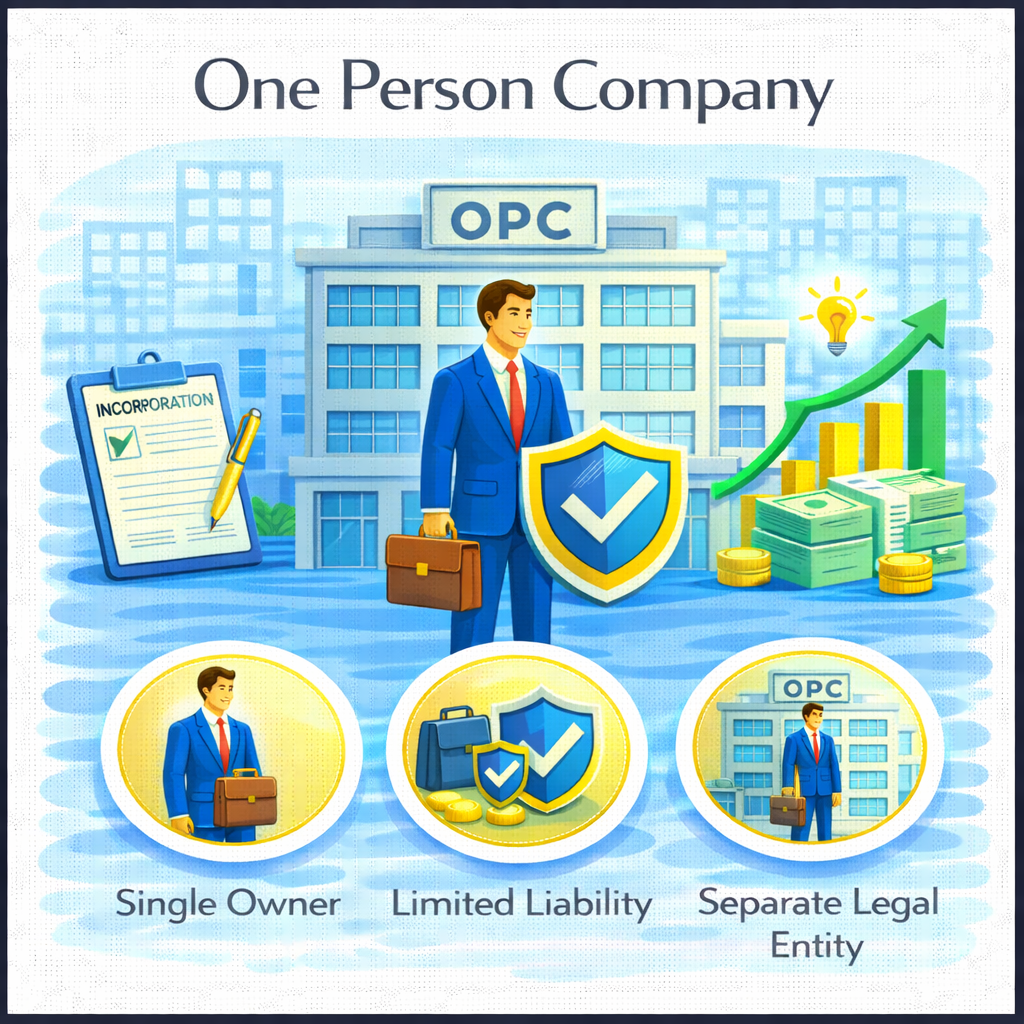
One Person Company (OPC) registration in India was introduced under the Companies Act, 2013, allowing a single individual to establish and operate a company with limited liability. This concept became effective with the implementation of the Act in 2013, marking a significant reform in India’s corporate framework.
The primary objective behind introducing OPCs was to promote entrepreneurship and support the formalization of Micro, Small, and Medium Enterprises (MSMEs). As per Section 2(62) of the Companies Act, 2013, an OPC can be formed with just one member and one director, and both roles can be held by the same person.
In simple terms, OPC registration enables a single entrepreneur to start a limited liability company in India while retaining complete control over management and decision-making. It blends the flexibility of a sole proprietorship with the legal protection and corporate status of a private limited company.
Before
proceeding with One Person Company (OPC)
registration, it is important to understand the eligibility conditions and
statutory limitations prescribed under the Companies Act, 2013 and the
Companies (Incorporation) Amendment Rules.
- Natural Person – Indian Citizen (Including NRI): As per the Companies (Incorporation) 2nd Amendment Rules, 2021, only a natural person who is an Indian citizen, whether resident in India or an NRI, is eligible to incorporate an OPC. (Resident in India means a person who has stayed in India for not less than 120 days during the immediately preceding financial year.)
- Minimum
Authorized Capital: An
OPC must have a minimum authorized capital of ₹1,00,000,
as stated in the capital clause during incorporation.
- Mandatory
Nominee Appointment: The
sole member must appoint a nominee at
the time of incorporation. The
nominee will become the member of the OPC in case of the promoter’s death or
incapacity. Prior
written consent of the nominee is required.
- Restrictions
on Certain Businesses: An
OPC cannot engage in certain financial activities such as; Banking, Insurance, Non-banking
financial investment activities.
- Mandatory Conversion into Private Limited Company: If; The paid-up share capital exceeds ₹50 lakhs, or The average annual turnover exceeds ₹2 crores, the OPC must be converted into a Private Limited Company in compliance with applicable regulations.
Note: An
individual can incorporate only one OPC
at a time and A
minor cannot become a member or nominee of an OPC.
To
complete the One Person Company (OPC)
registration process, certain documents must be prepared and filed with the
Registrar of Companies (ROC) in accordance with the Companies Act, 2013.
- Memorandum
of Association (MoA): Defines
the main objectives and scope of activities of the OPC.
- Articles
of Association (AoA): Specifies
the internal rules, governance structure, and management framework of the
company.
- Nominee’s
Consent (Form INC-3): Written
consent of the nominee in Form INC-3, Copy
of nominee’s PAN Card and Copy
of nominee’s Aadhaar Card.
- Proof
of Registered Office Address: Recent
utility bill (electricity, water, or gas bill not older than 2 months). Rent
Agreement and No Objection Certificate (NOC) from the owner (if premises is
rented).
- Director’s
Declaration and Consent: Declaration
by the proposed director in Form INC-9 and Consent
to act as director in Form DIR-2.
- Professional
Declaration: A
declaration from a qualified professional (CA/CS/CMA/Advocate) certifying that
all legal requirements and compliance procedures have been duly followed.
Keeping
these documents ready in advance ensures a smooth and timely OPC registration
process with the ROC.
The
key advantages of registering a One Person Company (OPC)
under the Companies Act, 2013 are outlined below:
- Separate
Legal Status: An
OPC enjoys a distinct legal identity separate from its owner. This means the
company can own assets, enter contracts, and take legal action in its own name.
The promoter’s personal assets remain protected from business liabilities.
- Limited
Liability Protection: The
liability of the sole member is limited to the amount invested in the company.
Personal financial risk is minimized in case of business losses.
- Easier
Fundraising: As
a corporate entity, an OPC generally has better credibility than a sole
proprietorship. It becomes easier to secure funding from banks, financial
institutions, angel investors, and venture capitalists.
- Reduced
Compliance Requirements: OPCs
benefit from certain exemptions and simplified compliance provisions compared
to other private limited companies, reducing administrative burden.
- Simple
Incorporation Process: An
OPC can be formed with just one member and one nominee,
and the same person can act as both shareholder and director. Additionally,
there is no minimum paid-up capital requirement,
making incorporation straightforward and cost-effective.
- Efficient
Decision-Making: Since
management rests with a single individual, decision-making is quick and
streamlined. This eliminates internal conflicts and delays common in
multi-member entities.
- Perpetual Succession: Through the appointment of a nominee, an OPC ensures business continuity even in the event of the sole member’s death or incapacity.
In
summary, OPC registration offers limited liability, operational efficiency,
reduced compliance, simplified management, and perpetual succession—making it
an attractive option for solo entrepreneurs seeking corporate status with full
control.
Related Services


Why Choose Arthtattava
Expert-Led Financial Solutions: Our team combines deep domain expertise with practical experience across industries.
End-to-End Accounting Support: From bookkeeping to reporting, we manage complete financial operations seamlessly.
Technology-Driven Approach: We leverage advanced tools like Tally, OCR, and automation for accuracy.
Customized Business Solutions: Every service is tailored to your business needs, scale, and growth stage.
Data Accuracy & Compliance Focus: We ensure error-free records while strictly adhering to regulatory requirements.
Reliable & Timely Delivery: Consistent turnaround times with proactive communication to support business decisions.
Know More Details