
×
The Employees’ Provident Fund (EPF) Scheme is a government-backed social security initiative designed to encourage long-term savings among employees and provide financial security after retirement. Through mandatory monthly contributions deducted from salaries, employees gradually build a retirement corpus. These accumulated funds can be withdrawn as a lump sum upon retirement or under specified conditions.
Under the EPF scheme, both the employer and employee contribute 12% of the employee’s basic salary. Out of the employer’s 12% contribution, 3.67% is credited to the employee’s EPF account, while 8.33% is allocated to the Employees’ Pension Scheme (EPS).
EPF withdrawals are permitted at retirement (on or after 58 years of age), after two months of unemployment, or by nominees in case of the member’s death before retirement.
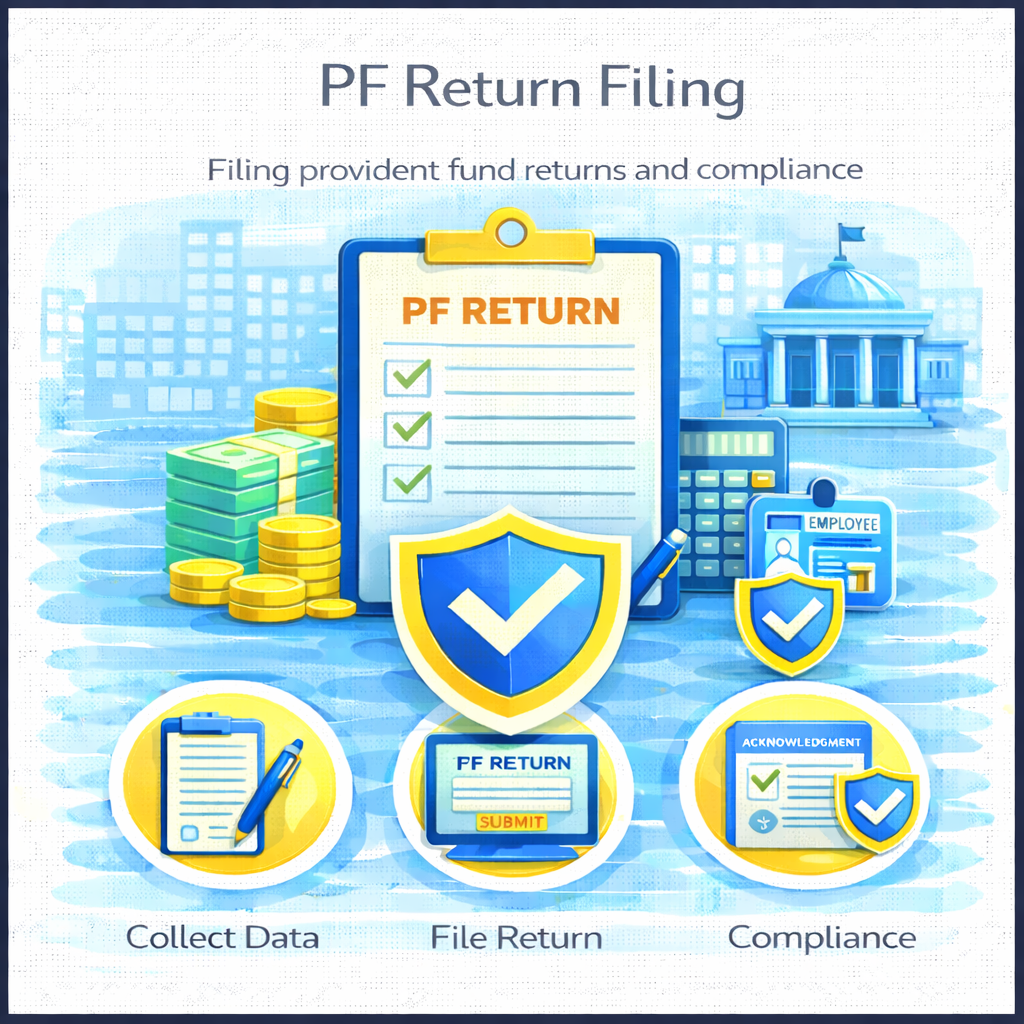
The
following entities are obligated to file PF returns:
- Establishments
Employing 20 or More Employees: Any
organization engaged in a specified industry or business that employs 20 or more employees is
mandatorily required to obtain EPF registration and comply with monthly PF
return filing requirements.
- Establishments
with Fewer than 20 Employees (Voluntary Registration): Organizations
employing fewer than 20 employees may voluntarily opt for PF registration. Once
registered, they are legally bound to comply with all EPF provisions, including
timely contribution payments and return filing.
- Eligible
Employees within Registered Establishments: All
employees earning wages up to the prescribed statutory limit (and those
voluntarily covered beyond the limit) are entitled to PF benefits. Employers
must include such employees in monthly filings and contributions.
- Compliance
Requirement: Registered establishments must file monthly PF returns and remit
contributions on or before the prescribed due date (generally the 15th of the
following month). Failure to comply may result in interest, penalties, and
legal action.
Timely PF return filing ensures statutory
compliance while safeguarding employees’ social security benefits.
The
following forms are used for Provident Fund (PF) registration and return filing
under the EPF framework:
- Form 5: Used to report newly joined employees and update employee details such as name, father’s name, date of birth, and other particulars.
- Form
10: Submitted
for declaration and nomination of beneficiaries by employees under the EPF and
Employees’ Pension Scheme (EPS).
- Form
3A: Contains
member-wise monthly contribution details of employees and employers for the
financial year.
- Form
12A: Utilized
for furnishing monthly details of PF contributions and administrative charges
payable by the employer.
- Form
6A: Annual
consolidated statement of contributions for all employees in the establishment.
Proper
submission of these forms ensures accurate record-keeping, statutory
compliance, and smooth administration of employee provident fund contributions.
For
accurate and timely filing of Provident Fund (PF) returns, employers must keep
the following documents and details ready:
- Employer’s
Contribution Details:
Complete record of the employer’s share of EPF and EPS contributions for the
relevant month.
- Employee’s
Contribution Details: Accurate
calculation and record of the employee’s PF deductions from salary.
- ECR
(Electronic Challan cum Return) Copy: Challan generated and submitted through the
EPFO portal as proof of contribution filing and payment.
- UAN
Details with KYC Compliance:
Updated Universal Account Number (UAN) information of all employees, including
verified KYC details such as Aadhaar, PAN, and bank account information.
Maintaining
these documents ensures smooth PF return filing, proper reconciliation, and
statutory compliance.
Regular
filing of Provident Fund (PF) returns provides significant advantages for both
employers and employees, including the following:
- Compliance
with Statutory Requirements: Filing PF returns within the prescribed due date is a
legal obligation. Timely compliance helps organizations avoid interest,
penalties, and other consequences arising from non-compliance.
- Employee
Financial Security: PF
contributions are a vital component of an employee’s long-term savings and
social security. Accurate and regular return filing ensures that employee and
employer contributions are properly recorded and credited.
- Tax
Benefits: PF contributions
qualify for tax deductions under applicable laws. Consistent filing supports
proper reporting and enables employers to claim eligible tax benefits
efficiently.
- Systematic
Record Management:
Regular return filing promotes organized documentation of PF contributions,
simplifying reconciliation, audits, and overall payroll administration.
Related Services


Why Choose Arthtattava
Expert-Led Financial Solutions: Our team combines deep domain expertise with practical experience across industries.
End-to-End Accounting Support: From bookkeeping to reporting, we manage complete financial operations seamlessly.
Technology-Driven Approach: We leverage advanced tools like Tally, OCR, and automation for accuracy.
Customized Business Solutions: Every service is tailored to your business needs, scale, and growth stage.
Data Accuracy & Compliance Focus: We ensure error-free records while strictly adhering to regulatory requirements.
Reliable & Timely Delivery: Consistent turnaround times with proactive communication to support business decisions.
Know More Details