
×
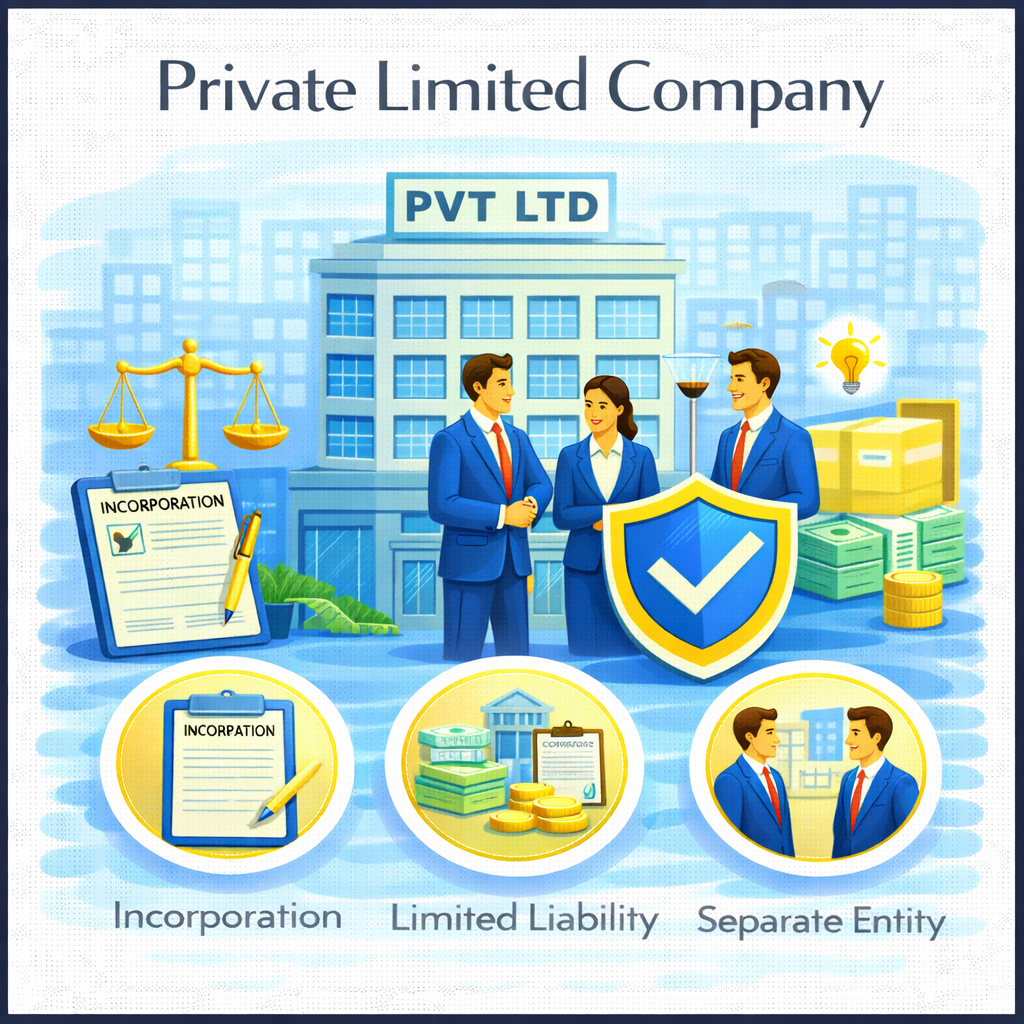
In India, a Private Limited Company is a privately owned business structure that offers limited liability protection to its shareholders. It is one of the most preferred forms of business organization due to its credibility, structured governance, and legal recognition. The key advantage of this structure is that it is treated as a separate legal entity, distinct from its owners, which means the company can own assets, enter into contracts, and incur liabilities in its own name.
The limited liability feature ensures that shareholders’ personal assets are protected and their liability is restricted to the amount invested in the company. Additionally, a Private Limited Company is relatively easy to incorporate and maintain compared to public companies, while offering greater access to funding and business expansion opportunities.
To incorporate a Private Limited Company in
India, a minimum of two members (shareholders) and two directors is required.
This structure provides a clear distinction between ownership and management,
promoting transparency and organized business operations.
Entrepreneurs
planning to start a company in India should carefully understand the different
types of companies available under the Companies Act before proceeding with
registration. The structure selected directly impacts liability, compliance,
and financial responsibilities.
- Company
Limited by Shares: In
this type of company, the liability of shareholders is limited to the unpaid
amount on the shares held by them, as specified in the Memorandum of
Association (MOA). This is the most common form of private limited company in
India.
- Company
Limited by Guarantee: Here,
the liability of members is limited to the amount they agree to contribute
(guarantee) to the company’s assets in the event of winding up. This structure
is generally used for non-profit organizations, clubs, or associations.
- Unlimited
Company: In an unlimited
company, members have unlimited personal liability for the company’s debts.
However, the company remains a separate legal entity distinct from its members.
Understanding
these structures thoroughly is essential before proceeding with company
registration in India.
To
incorporate a Private Limited Company through
the SPICe+ (INC-32) form under the
Companies Act, 2013, the following documents are required:
When Director and Subscriber are Indian Nationals:
- Declaration
by Subscribers and Directors: A
declaration confirming their intention to become shareholders and/or directors
of the company, as prescribed under the Act.
- Proof
of Registered Office Address: If
Rented/Leased Premises; Rent/Lease
Agreement and No
Objection Certificate (NOC) from the property owner. If
Owned Premises; Ownership
document (e.g., Sale Deed or Property Tax Receipt).
- Utility
Bill of Registered Office: Latest
electricity bill, water bill, or gas bill (not older than 2 months) reflecting
the registered office address.
- Name
Approval Supporting Documents (if applicable): If
the proposed company name contains restricted words requiring Central
Government approval, attach the approval letter or If
the proposed name is based on a registered trademark or pending trademark
application, attach the Trademark Registration Certificate or Trademark
Application copy.
- Identity
and Address Proof of Directors/Subscribers: PAN
Card (mandatory for Indian nationals), Aadhaar
Card / Passport / Voter ID / Driving License (as identity and address proof), In
case the proposed director does not have a DIN, valid identity and address
proof must be submitted for DIN allotment.
When Director and Subscriber are Foreign Nationals:
- Passport: A
valid passport (notarized and apostilled/consularized, as applicable) is
mandatory.
- Address
Proof (Any One of the Following): Driving
License or Residence
Card or Bank
Statement or Government-issued
Identity Document containing the current residential address.
All
foreign documents must be notarized and, where applicable, apostilled or
consularized as per Indian regulations.
A Private Limited Company is one
of the most preferred business structures in India due to its flexibility,
credibility, and growth potential. Below is a refined explanation of its key
advantages:
- Limited
Liability Protection: The
liability of shareholders is limited to the amount invested in the company.
Their personal assets remain protected from the company’s debts and financial
liabilities.
- Separate
Legal Identity: A
Private Limited Company has a distinct legal existence separate from its
owners. It can own property, enter into contracts, sue, and be sued in its own
name.
- Perpetual
Succession: The
company continues to exist irrespective of changes in shareholders or
directors. Its continuity is not affected by death, resignation, or transfer of
ownership.
- Easy
Access to Funding: This
structure makes it easier to raise capital by issuing shares to investors,
venture capitalists, and angel investors. It enhances growth opportunities and
reduces capital constraints for entrepreneurs.
- Tax
Advantages: Private
Limited Companies may avail themselves of various tax benefits, deductions, and
exemptions as per applicable laws, making them comparatively tax-efficient.
- Enhanced
Credibility and Trust: Having
“Pvt. Ltd.” in the company name enhances credibility and builds confidence
among customers, suppliers, financial institutions, and business partners.
If
you would like, I can also prepare a disadvantages section to make it a
complete comparison for your website or brochure.
Related Services


Why Choose Arthtattava
Expert-Led Financial Solutions: Our team combines deep domain expertise with practical experience across industries.
End-to-End Accounting Support: From bookkeeping to reporting, we manage complete financial operations seamlessly.
Technology-Driven Approach: We leverage advanced tools like Tally, OCR, and automation for accuracy.
Customized Business Solutions: Every service is tailored to your business needs, scale, and growth stage.
Data Accuracy & Compliance Focus: We ensure error-free records while strictly adhering to regulatory requirements.
Reliable & Timely Delivery: Consistent turnaround times with proactive communication to support business decisions.
Know More Details