
×
Professional
Tax is a state-level direct tax levied by State Governments and Union
Territories on income earned through salary, profession, trade, or employment.
Unlike Income Tax, which is imposed by the Central Government, Professional Tax
is governed by respective state legislation and rules.
- Employers
are responsible for deducting Professional Tax from employees’ salaries and
remitting it to the state government within the prescribed timelines.
- Self-employed
professionals, freelancers, and business owners must register, pay, and file
Professional Tax on their own.
- The maximum amount of Professional Tax payable is capped at ₹2,500 per year, as per constitutional provisions.
- The annual Professional Tax Enrollment Certificate (PTEC) renewal fee for Self-employed Individuals and Business entities is ₹2,500.
A
Professional Tax Return is a statutory statement filed with the respective
state tax department that includes details such as:
- Salary
or income paid during the period
- Professional
Tax deducted from employees or paid by the assessee
- Proof
of tax remittance for the relevant period
Depending
on the state regulations, Professional Tax returns may be required to be filed
on a monthly, quarterly, or annual basis (including Annual Return, where
applicable).
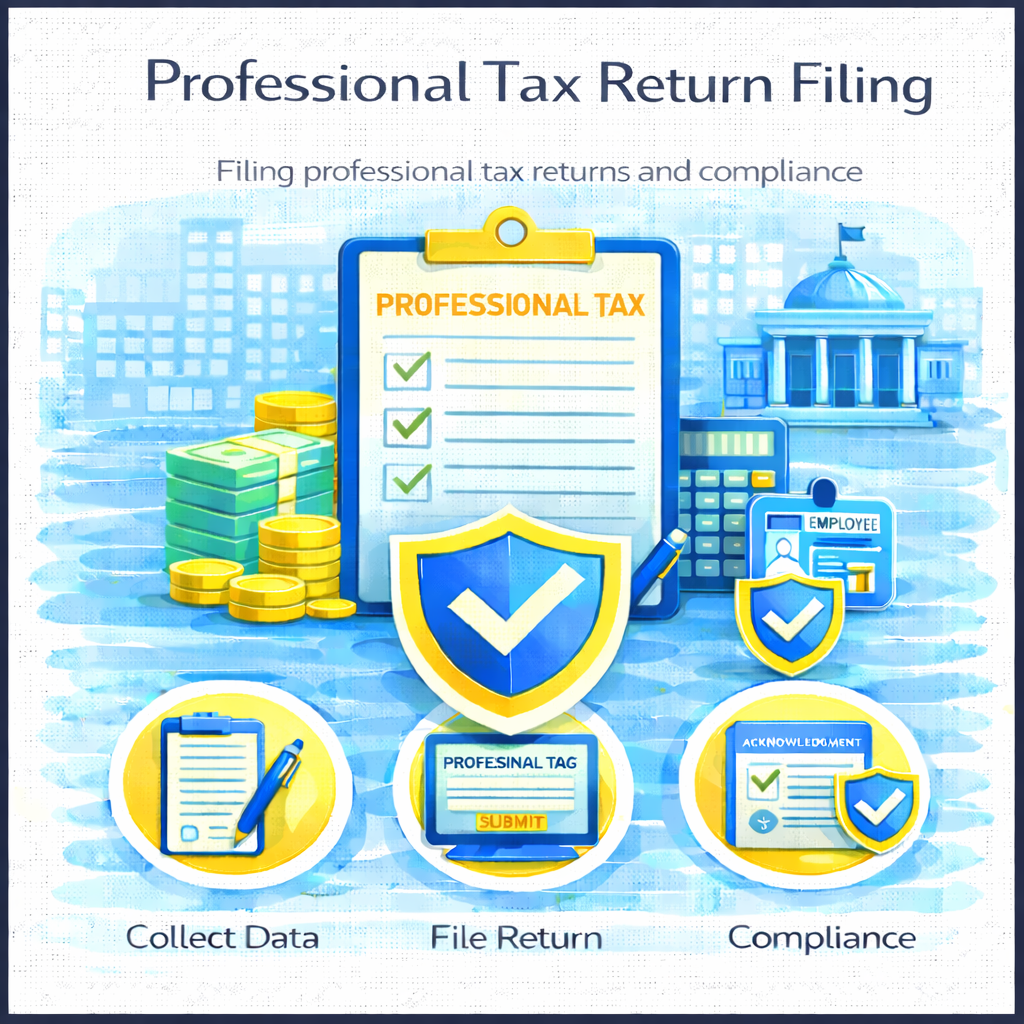
Professional
Tax Return Filing is mandatory for the following categories of persons and
entities:
- Employers
registered under Professional Tax (PTRC): Any employer holding a Professional Tax
Registration Certificate is required to deduct and remit tax and file periodic
returns.
- Businesses
employing staff:
All establishments employing eligible employees must comply with deduction and
return filing requirements.
- Self-employed
professionals and practitioners:
Individuals such as consultants, freelancers, doctors, lawyers, and other
professionals must register (where applicable), pay, and file returns directly.
- Entities
registered under the Shops and Establishments Act: Registered commercial establishments are
generally required to obtain Professional Tax registration and comply with
return filing provisions.
In
the case of salaried employees, the responsibility for deduction, payment, and
filing of Professional Tax returns lies with the employer.
To
ensure accurate and timely Professional Tax return filing, the following
documents and details are generally required:
- PAN
Card of
the individual or entity
- Aadhaar Card (for identity verification, where applicable)
- Identity
Proof
such as Voter ID or Passport
- Bank
Account Details
for verification and payment tracking
- Salary
or Income Details of
employees or self-employed professionals
- Shops
& Establishment Registration Certificate (if applicable)
- PTRC
/ PTEC Registration Certificate
- Professional
Tax Payment Challans as
proof of tax remittance
- TDS
Details
(if applicable for reconciliation purposes)
Additional
documents may be required depending on the specific rules and compliance
requirements of the respective state.
- Avoid
Penalties and Interest:
Timely filing helps prevent late fees, interest charges, and potential legal
proceedings arising from non-compliance.
- Ensure
Statutory Compliance:
Regular return submission ensures adherence to applicable state Professional
Tax laws and regulations.
- Enhance
Business Credibility:
Proper compliance strengthens the organization’s reputation and demonstrates
responsible governance during audits and inspections.
- Access
to Government Registrations and Tenders: Updated Professional Tax compliance may be
required for certain licenses, registrations, and participation in government
contracts or schemes.
- Maintain
Clean Compliance Records:
Consistent filing supports accurate documentation and simplifies future
reconciliations or assessments.
- Contribute
to State Development:
Professional Tax collections support state revenue, aiding in public
infrastructure and welfare initiatives.
Related Services


Why Choose Arthtattava
Expert-Led Financial Solutions: Our team combines deep domain expertise with practical experience across industries.
End-to-End Accounting Support: From bookkeeping to reporting, we manage complete financial operations seamlessly.
Technology-Driven Approach: We leverage advanced tools like Tally, OCR, and automation for accuracy.
Customized Business Solutions: Every service is tailored to your business needs, scale, and growth stage.
Data Accuracy & Compliance Focus: We ensure error-free records while strictly adhering to regulatory requirements.
Reliable & Timely Delivery: Consistent turnaround times with proactive communication to support business decisions.
Know More Details