
×
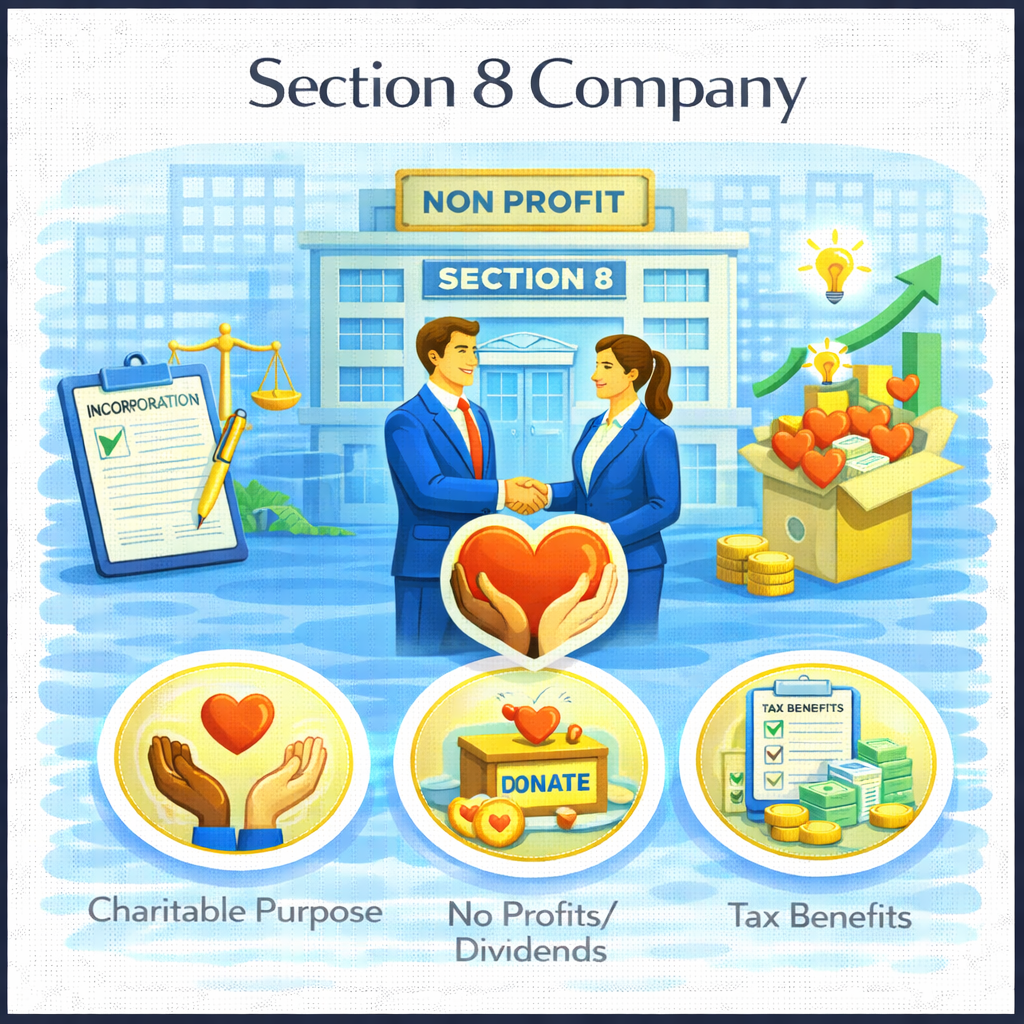
A Section 8 Company is a special type of corporate entity formed to promote non-profit objectives such as education, social welfare, environmental protection, arts, sports, research, charity, and similar activities. It is incorporated in accordance with the provisions of the Companies Act, 2013.
The primary purpose of registering a Section 8 Company is to advance charitable and socially beneficial goals, including trade promotion, commerce, arts, education, environmental sustainability, sports development, research, and community welfare. The profits or income generated by the company must be applied solely toward achieving these objectives and cannot be distributed as dividends to its members.
For incorporation, a minimum of two directors is required in the case of a private limited structure (and three in case of a public limited structure). Additionally, there is no minimum paid-up capital requirement, making it accessible for individuals and organizations aiming to establish a structured non-profit entity with legal recognition and credibility.
The
eligibility criteria for forming a Section 8 Company
are prescribed under the Companies Act, 2013. The key conditions are outlined below:
Eligible
Persons:
- An Indian citizen can incorporate
a Section 8 Company.
- A Hindu Undivided Family (HUF),
through its authorized representative, may also participate in incorporation.
- Associations
of individuals or existing entities intending to promote charitable objectives
are also eligible.
Minimum
Directors Requirement:
- A
minimum of two directors is required if
the company is incorporated as a private limited structure.
- A
minimum of three directors is required if
incorporated as a public limited structure.
- At
least one director must be a resident in India.
Charitable
Objective: The
primary objective of the Section 8 Company must be to promote non-profit
activities such as:
- Art
and science
- Education
- Sports
- Social
welfare
- Environmental
protection
- Charity
- Providing
financial assistance to economically weaker sections
Additionally,
the company must apply its income solely toward these objectives and must not
distribute profits as dividends to its members.
To
successfully incorporate a Section 8 Company
under the Companies Act, 2013, the following documents must be prepared and
submitted to the Registrar of Companies (ROC):
Constitutional
Documents:
- Memorandum
of Association (MOA) –
Stating the charitable objectives of the company.
- Articles
of Association (AOA) –
Defining the internal management rules and governance structure.
Declarations
by Directors and Subscribers: Declaration
by the first director(s) and subscriber(s) confirming compliance with legal
requirements (affidavit not required).
Registered
Office Address Proof:
- Recent
utility bill (electricity, water, or gas bill) not older than 2 months.
- Rent
Agreement and No Objection Certificate (NOC) from the owner (if the premises is
rented).
Identity
and Residential Proof:
- PAN
Card (mandatory for Indian nationals).
- Aadhaar
Card / Passport / Voter ID / Driving License.
- Address
proof such as bank statement or utility bill (recent).
Digital
Signature Certificate (DSC): All
proposed directors must obtain a valid DSC to digitally sign incorporation
forms filed with the MCA portal.
Additional
Documents (If Applicable):
- Copy
of Certificate of Incorporation (COI) of an overseas corporate body (if a
foreign entity is a subscriber).
- Board
Resolution passed by the promoter company authorizing investment/incorporation.
- Declaration
regarding unregistered companies (if applicable).
Submitting
accurate and complete documentation ensures a smooth and efficient Section 8
Company incorporation process.
Incorporating
a Section 8 Company under the
Companies Act, 2013 offers several significant advantages for organizations
working toward charitable and social objectives. Some of the key benefits are
outlined below:
- Tax
Exemptions: Section
8 Companies registered under Section 12AA (now 12AB) of the Income Tax Act may
be eligible for tax exemptions, provided they apply their income solely toward
charitable purposes. This ensures that surplus funds are reinvested into
achieving their objectives rather than being taxed as profits.
- No
Minimum Capital Requirement: Unlike
many other corporate structures, Section 8 Companies are not required to
maintain a minimum paid-up capital. This allows flexibility in structuring
funds according to the organization’s operational and growth needs.
- Separate
Legal Entity: A
Section 8 Company enjoys a distinct legal identity separate from its members.
It has perpetual succession, meaning it continues to exist regardless of
changes in its directors or members. This strengthens its legal standing and
operational independence.
- Enhanced
Credibility: Due
to strict regulatory and compliance requirements, Section 8 Companies often
enjoy higher credibility compared to unregistered NGOs or trusts. Their
structured governance framework builds trust among donors, government
authorities, and stakeholders.
- No
Mandatory Suffix: Unlike
other companies that must use “Private Limited” or “Limited” in their name, a
Section 8 Company is not required to add these suffixes. This provides greater
flexibility in choosing a suitable name.
- Stamp
Duty Benefits: In
many states, Section 8 Companies enjoy exemptions or reduced stamp duty during
incorporation, reducing initial registration costs.
Overall,
a Section 8 Company provides tax advantages, operational flexibility, legal
recognition, and enhanced credibility—making it an ideal structure for
individuals and organizations aiming to pursue charitable, social, or
non-profit initiatives in India.
Related Services


Why Choose Arthtattava
Expert-Led Financial Solutions: Our team combines deep domain expertise with practical experience across industries.
End-to-End Accounting Support: From bookkeeping to reporting, we manage complete financial operations seamlessly.
Technology-Driven Approach: We leverage advanced tools like Tally, OCR, and automation for accuracy.
Customized Business Solutions: Every service is tailored to your business needs, scale, and growth stage.
Data Accuracy & Compliance Focus: We ensure error-free records while strictly adhering to regulatory requirements.
Reliable & Timely Delivery: Consistent turnaround times with proactive communication to support business decisions.
Know More Details